
How to Choose a Multi-Day Wedding Venue in France
Updated: Oct 26

A venue that works beautifully for a Saturday wedding does not necessarily work well for a three-day destination wedding.
For a single-day celebration, you may primarily need a ceremony location, cocktail space, dinner setting, dance floor, and a workable rain plan. For a multi-day destination wedding in France, the venue becomes something closer to a temporary home base.
Guests may arrive on Friday, meet for drinks that evening, spend Saturday at the wedding, return for brunch on Sunday, and perhaps stay on the property throughout the weekend.
That changes what “the right venue” means.
You are no longer evaluating only whether you love the château, domaine, villa, or mas. You are evaluating whether the property can support the sequence of experiences you want to create without turning every additional event into another transportation plan, supplier setup, weather contingency, or unexpected cost.
Start With the Weekend You Want — Not the Venue
Before comparing properties, sketch the weekend at a very simple level.
For example:
Friday
Guest arrivals → welcome drinks → casual dinner
Saturday
Breakfast → getting ready → ceremony → cocktail hour → dinner → dancing
Sunday
Late breakfast or brunch → pool afternoon or farewell gathering → departures
Your version may be completely different. You might want a welcome dinner in town, the wedding at a château, and brunch at a vineyard. Or you may want everyone to arrive at one estate on Friday and barely leave until Sunday.
The important part is identifying which experiences you actually want before allowing a venue package to define the weekend for you.
Once you have that outline, every venue becomes easier to evaluate. Instead of asking, “Can we have a wedding here?” you can ask:
Can this property support the wedding weekend we want?
If you are still deciding how to structure those days, start with How to Plan a Wedding Weekend in France before assigning events to locations.
Confirm Exactly When the Venue Becomes Yours
For a multi-day wedding, do not assume that booking a property for several nights automatically gives you unrestricted use of every event space for the same period.
There may actually be three different timelines:
Guest access — when you and your guests can arrive, use the property, and check into bedrooms.
Event access — when the ceremony, reception, welcome dinner, brunch, and other event spaces are available to you.
Vendor access — when your planner, florist, caterer, rental company, lighting team, musicians, and other vendors can begin setup and when everything must be removed.
These timelines can be very different.

Your guests might check in Friday afternoon while your florist needs access Friday morning. Your Sunday brunch may end at 2 p.m. while bedrooms require checkout at 10 a.m. Furniture may need to remain on the property until Monday even though your own booking ends Sunday.
Ask for all three timelines before deciding whether the venue truly works for your weekend.
If a proposal uses the term privatisation, confirm exactly what that exclusive use covers. For a deeper explanation of how French venues may use this term, see What Does “Privatisation” Mean When Booking a Wedding Venue in France?
Separate Event Capacity From Accommodation Capacity

A château may host 120 people for dinner and sleep 28.
Those are two completely different capacities.
For a destination wedding, accommodation on the property can significantly change the structure of the weekend. But the existence of bedrooms tells you very little until you know how many of your actual guests can use them.
Imagine a 100-person wedding at a venue sleeping 30.
That leaves 70 guests off-site. Those guests need accommodation elsewhere. Once you know where they will stay, you can determine pickup points. Once pickup points are known, you can build shuttle routes. Only then can you properly understand the transportation required.
The real chain is:
On-site beds → off-site guests → accommodation hubs → pickup points → shuttle routes → transportation cost and complexity.
This is why two equally appealing venues with the same wedding capacity can produce very different destination-wedding experiences.
For the next step, see France Wedding Guest Accommodation Guide: Where Should Your Guests Stay?
Decide Who Actually Needs to Stay at the Venue
You do not necessarily need a venue that sleeps every guest.
Trying to accommodate everyone on one property can unnecessarily eliminate venues that otherwise fit your wedding extremely well.
Instead, decide what you want the accommodation to accomplish.
Perhaps the venue needs to sleep only the couple, immediate family, and wedding party. Perhaps your priority is keeping 30–40 close friends together while everyone else stays in nearby hotels.
Or perhaps the entire appeal of the wedding is a residential weekend where nearly everyone wakes up and has breakfast together.
Those are different wedding formats.
Also investigate the actual bedroom configuration rather than relying on total sleeping capacity. Ten rooms that technically sleep four people each are not equivalent to 20 double rooms for adult couples.
Ask for a room list whenever possible, including bed configuration, bathrooms, accessibility, air conditioning where relevant, and any family rooms or additional beds.
Check Whether On-Site Accommodation Is Optional or Required
Accommodation may also be part of the venue's commercial model.
A property may require the couple to reserve a minimum number of rooms, book all available accommodation, or commit to a minimum stay as part of the wedding booking.
That is not automatically a disadvantage.
If you already want a residential wedding weekend, it may fit your plans perfectly.
But it changes how you compare prices.
A venue fee combined with mandatory accommodation is not directly comparable with a similar venue fee at a property where guests independently reserve and pay for their rooms.
A more useful comparison is:
Venue hire + required accommodation + required services + essential extras = real comparable venue cost.
Then decide who will pay for the bedrooms: the couple, the guests, or some combination of both.
If guests will book individually, also ask about minimum stays, payment deadlines, cancellation terms, and check-in and checkout times. A 10 a.m. Sunday checkout can create a very different experience from the relaxed farewell brunch you imagined at noon.
Make Sure Friday and Sunday Actually Work as Event Days
One of the easiest mistakes in planning a wedding weekend is assuming that because you have access to a property for several days, you can host events there for several days.
Those are not necessarily the same thing.
If you want Friday welcome drinks or dinner, confirm where they can take place, how many people the space accommodates, whether catering is permitted, how beverages are handled, and what restrictions apply to music.
Then repeat the exercise for Sunday.
A brunch may sound operationally simple, but it can require catering, staff, tables, chairs, tableware, coffee service, cleaning, and another setup.
If Saturday's rentals are scheduled for collection Sunday morning, can they remain for brunch? If not, extending the rental period or creating a second setup may materially change the cost.
A venue that advertises “three-day weddings” is therefore not enough. You need to understand what can actually happen on each of those three days.
Look at What Happens Between the Events
Multi-day weddings contain much more unstructured time than a traditional wedding day.
Where do 30 overnight guests have coffee on Saturday morning?
Where can people sit while others get ready?
If friends arrive several hours before welcome drinks, is there somewhere comfortable for them to wait?
What happens Sunday afternoon if some guests have evening flights?
A venue may have impressive formal event spaces but very little usable communal space outside them.

For a residential wedding weekend, lounges, terraces, gardens, shaded seating, breakfast areas, pools, casual dining spaces, and even somewhere to make coffee can matter more than another formal salon.
You are evaluating not only where the events happen, but where people live between the events.
Look for Spaces That Can Change Function Across the Weekend
A multi-day wedding does not require a different spectacular location for every gathering.
It needs enough functional variety that the weekend does not feel as though every event happens around the same tables in the same room.
A courtyard might host Friday drinks. A garden could become the ceremony location. A terrace might work for cocktail hour. Dinner could take place in an orangerie or reception room. Sunday brunch could return to the terrace in a much more relaxed configuration.
The same property can therefore feel different from event to event without requiring enormous grounds.
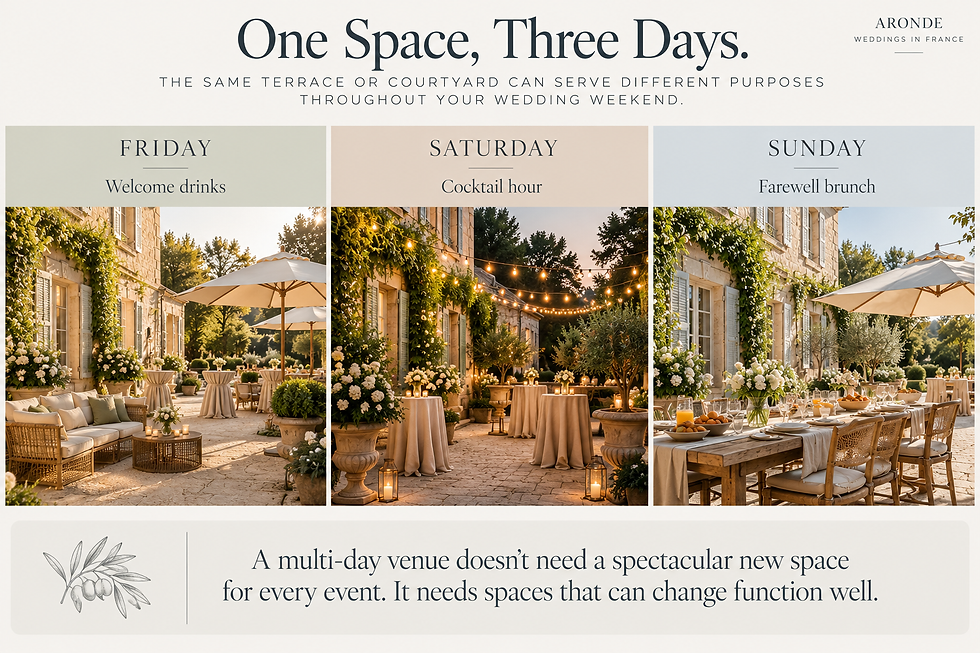
What matters is whether each space works for your guest count, weather, furniture, catering, accessibility, noise restrictions, and movement between events.
A beautiful photograph of a courtyard does not tell you whether 100 people can comfortably eat there.
Evaluate the Rain Plan for the Entire Weekend
Most couples remember to ask what happens if it rains during the ceremony.
For a multi-day destination wedding, that question is too narrow.
What happens to Friday drinks?
Where does Saturday's cocktail hour move?
Can the full guest count eat indoors?
Where does Sunday brunch happen?
More importantly, can those backup spaces perform several functions across the weekend?
Suppose the indoor reception room becomes Saturday's rain plan. If it then needs to be completely reset overnight for Sunday brunch, who performs the reset, when can they access the room, and does it create another staffing or cleaning charge?
Or imagine that the indoor backup accommodates 80 seated guests while your wedding has 110. The venue technically has a rain plan, but it does not have a usable rain plan for your wedding.
A useful distinction is:
Availability ≠ usability ≠ suitability.
If weather flexibility is likely to influence your shortlist, How to Evaluate a French Wedding Venue's Rain Plan explains how to assess the backup plan in more detail.
Pay Attention to the Getting-Ready Experience
When the couple and wedding party are staying at the venue, Saturday morning becomes part of the venue experience too.
Do not assume that the most impressive bedroom is automatically a good getting-ready space.

Think about how many people will realistically be there: the person getting married, friends, photographer, videographer, hair and makeup artists, and perhaps family members.
Then consider mirrors, electrical outlets, bathrooms, seating, ventilation, natural light, and enough physical space for everyone to work without constantly moving bags and furniture.
In summer, confirm exactly which rooms are air-conditioned.
Historic French properties may have AC in some bedrooms but not necessarily every suite, salon, or getting-ready area.
The difference may seem minor during a winter venue tour and become much more significant on a hot summer morning.
The room also becomes part of the visual story of the day. If you are thinking about how you want that part of the wedding photographed, see Wedding Morning Photo Ideas: 4 Ways to Photograph Getting Ready.
If Your Dog Is Part of the Wedding Weekend, Ask More Than “Are You Pet-Friendly?”
For some couples, the dog is not simply traveling to France with them. They imagine their dog staying at the venue, being present while they get ready, appearing in photographs, walking down the aisle, or simply spending the weekend alongside their closest family and friends.
In that case, “pet-friendly” is not enough information.
A pet-friendly hotel is not necessarily a pet-friendly wedding venue.
A property may allow dogs in selected guest rooms while prohibiting them from restaurants, formal gardens, pool areas, or event spaces. A hotel policy allowing pets overnight therefore does not necessarily mean your dog can participate in the wedding.
Explain what you actually intend to do and ask which parts are permitted.
Can your dog attend the ceremony?
Cocktail hour?
Dinner?
Can the dog be inside the reception space?
Can animals be left unattended in bedrooms?
Are there size restrictions, cleaning charges, or additional deposits?
Then look at the property itself. A large unfenced estate, swimming pool, pond, livestock, gravel courtyard, or busy service area may change how easily your dog can spend the weekend there.
Finally, decide who will be responsible for the dog when you cannot be. During the ceremony, couple portraits, dinner, speeches, or dancing, a trusted guest, sitter, walker, or wedding-day pet chaperone may be more practical than giving the responsibility to someone who is also trying to enjoy the wedding.
If bringing your dog matters to you, establish these rules before signing the venue contract, not after.
Ask How Catering Works Across Multiple Events
A venue's catering policy can have a much larger effect on a wedding weekend than on a single reception.
Some properties have an in-house restaurant or culinary team. Others work with selected traiteurs, the French term you may encounter for professional caterers. Some allow outside catering, while others restrict your choice.
Now multiply that decision across the weekend.
Who provides Friday dinner?
Who handles breakfast for overnight guests?
Who caters Saturday?
Who serves Sunday brunch?
If the same caterer is working several events, can they use or store equipment in the venue kitchen throughout the weekend?
If several suppliers are involved, when can each access the kitchen and service areas?
Also establish what the venue actually provides: tables, chairs, glassware, linens, tableware, kitchen equipment, staff, cleaning, and waste removal.
If you intend to supply your own wine or Champagne, ask whether a droit de bouchon, or corkage charge, applies.
The least expensive-looking catering arrangement can become much less attractive once staffing, equipment, kitchen access, rentals, cleaning, and multiple services are added.
Find Out Who Feeds Everyone — and Who Takes Care of the Property
When you book a château for a wedding weekend, it is easy to focus on Saturday's wedding dinner.
But what happens on Friday morning, Saturday at lunchtime, or Sunday before everyone leaves?
Imagine 30 guests staying at a private estate for three nights.
Who makes breakfast each morning?
Is it included in their accommodation, provided by the venue, arranged through an outside caterer, or entirely self-service?
If guests spend Saturday at the pool before the ceremony, is lunch available?
Can they buy something nearby?
Does the property have a restaurant, or would you need to organize another meal?
And who clears the breakfast dishes, cleans the kitchen, empties the bins, and keeps shared bathrooms and communal areas usable throughout the weekend?
These arrangements vary considerably between a staffed hotel, a privately rented château, and a self-catering estate.
Before booking, establish:
Breakfast: Is it included? Who prepares and serves it? At what times?
Lunch and casual meals: Can guests purchase food on-site, arrange delivery, use the kitchen, or walk to a restaurant?
Kitchen access: Are guests allowed to cook? Is the kitchen equipped for the number of people staying?
Cleaning: Is daily housekeeping included, or is cleaning provided only before arrival and after departure?
Shared spaces: Who cleans communal bathrooms, dining areas, terraces, and kitchens during the stay?
Staffing: Is someone available to assist guests, replenish supplies, and respond to problems?
Additional charges: Do breakfasts, cleaning, extra staff, or extended services need to be booked and paid for separately?
Also distinguish between cleaning the guest accommodation and resetting the venue for the next event. These may be handled by entirely different teams.
For example, Saturday's wedding caterer may clear the reception tables but have no responsibility for Sunday breakfast. The venue's cleaning team may prepare bedrooms before check-in without providing daily housekeeping.
None of these arrangements is necessarily a problem.
A self-catering château can be an excellent choice for a relaxed wedding weekend, especially if you enjoy the idea of shared meals and an informal atmosphere.
But a self-catering property for 30 guests is very different from a hotel with 30 overnight guests.
Before choosing the venue, decide how much of the weekend you want to organize yourself — and how much you expect the property to handle.
Understand Who Resets the Venue Between Events

Friday's dinner must become Saturday's wedding. Saturday night's party may need to become Sunday's brunch.
Someone has to do that work.
If furniture needs moving, flowers need relocating, rubbish needs removing, floors need cleaning, tableware needs replacing, or breakfast needs setting up while guests sleep, determine who is responsible.
Do not assume that “venue hire for the weekend” includes staff continuously resetting the property.
Ask who handles setup, cleaning between events, overnight resets, breakdown, and additional labor.
Also establish where vendors can leave equipment between events without filling guest areas with cases, boxes, floral mechanics, or rental equipment.
These details determine whether Sunday morning feels relaxed or whether your guests wake up in a reception venue halfway through being dismantled.
Understand Vendor Access Across the Whole Weekend
Your florist may want to begin installation on Friday. A lighting company may need longer. Furniture may arrive before guests, while some rentals may remain until Monday.
Ask where vehicles can unload, whether larger delivery vehicles can reach the setup area, where equipment can be stored, and exactly when everything must be removed.
These details become particularly important at historic properties reached through narrow village streets, restricted gates, courtyards, or rural lanes.
A difficult unloading point can change the number of people or hours a supplier needs for installation even when the event space itself is perfectly suitable.
Investigate Music and Curfews Before Designing the Weekend
A rural château can feel completely private while still operating under venue rules, neighbor considerations, or contractual limits on amplified music.
Do not assume that being far from a city means you can dance outside until 2 a.m.
Ask separately about outdoor music, indoor music, live bands, DJs, the time at which the party must move indoors, any requirement to close doors or windows, and the final end time.
Then ask what actually happens at the cutoff.
Does the DJ stop completely?
Can dancing continue indoors?
Can guests remain outside without amplified music?
Does the bar close at the same time?
This is particularly important for a wedding weekend because the venue may also be where some of your guests are sleeping. A property can be excellent for a relaxed residential weekend while being poorly suited to a couple whose highest priority is a very late party.
If dancing late is important to you, Wedding Venue Curfews in France: What to Ask About Music & Dancing goes deeper into what to confirm before booking.
Think About Transportation as Part of the Venue
For an international wedding, the venue's location cannot be evaluated only by driving time from the nearest airport or train station.
Think about the entire guest journey.
How will guests arrive?
Will most rent cars?
Is the final section of the route straightforward?
Can taxis realistically be arranged?
Where will off-site guests stay?
Can coaches reach the property?

That final question matters more than it appears.
A château may have parking but still have a narrow gate, difficult village approach, restricted turning space, low branches, or no suitable waiting area for a full-size coach.
“Parking available” therefore does not automatically mean “guest shuttle logistics solved.”
If 70 guests are staying off-site, coach access may become more important than parking capacity.
Once you know where guests are likely to stay, you can turn accommodation choices into actual shuttle routes. Wedding Transportation in France: Complete Guide covers that planning step in more detail.
Think About What Guests Can Actually Do Without a Car
A beautiful countryside château can feel like the perfect place to spend a wedding weekend. But imagine arriving on Friday, settling into your room, and discovering that the nearest café, restaurant, or village is a 20-minute drive away.
Now imagine you didn't rent a car.
This is an important distinction when choosing a multi-day wedding venue in France, especially if many of your guests are traveling from the United States or other countries.
Do not assume everyone will want to rent a car just to attend your wedding.
Before booking, consider what an ordinary Saturday morning or Sunday afternoon might look like for someone staying at the property.
Can guests walk to a café, bakery, restaurant, or village?
If the venue is isolated, can guests comfortably spend several hours there without scheduled activities?
Is there a pool, garden, lounge, or another communal space where people can relax?
If guests want to explore the region, can they arrange transportation independently?
Are local taxis or private drivers realistically available, including evenings and weekends?
Will anyone need transportation just to buy food, visit a pharmacy, or get to a train station?
A swimming pool and beautiful gardens may be enough for a relaxed residential weekend. But they are not necessarily enough if guests need to organize every meal themselves and cannot leave the property without a car.
You do not need to provide a full entertainment program or organize every excursion.
The goal is to understand how independently your guests can enjoy their time.
A venue can be wonderfully secluded and still work for a multi-day wedding — as long as that seclusion is part of the plan rather than an unexpected problem.
Decide Whether You Want One Wedding Hub or Several Experiences
There are two fundamentally different ways to build a destination wedding weekend.
One is venue-centered.
Guests arrive at the estate and most of the weekend happens there: welcome dinner, wedding, brunch, perhaps a pool afternoon. Transportation is concentrated around arrivals, departures, and off-site accommodation.
The other is destination-centered.
Friday dinner might be in a village restaurant, Saturday at the wedding venue, and Sunday at a vineyard, beach club, or another property. Guests experience more of the region, but every additional location introduces transportation, timing, accessibility, reservations, weather planning, and logistics.
Neither structure is inherently better.
Ask what you want guests to remember:
Living together at one place for a weekend — or experiencing a part of France together?
That answer may eliminate venues more effectively than another hour spent comparing photographs.
Do Not Confuse a Beautiful Estate With a Guest-Friendly Estate
For a destination wedding, guests interact with the venue for much longer than they would at a local wedding.
Look at the property from their perspective.
Historic staircases, gravel courtyards, distant guest houses, uneven paths, and rooms without elevators can be part of the character of an old French estate. They can also matter considerably for grandparents, guests with mobility limitations, parents with strollers, or anyone carrying luggage.
Do not stop at asking whether the venue is “accessible.”
Trace the actual route:
Arrival → bedroom → ceremony → cocktail hour → dinner → bathrooms → dancing → shuttle pickup.
A step-free ceremony location is of limited value if the accessible bathroom or dinner room cannot be reached by the same guest.
The same principle applies to comfort. For a summer wedding, identify where guests can escape the heat. In a cooler or wetter season, understand which communal indoor spaces are available outside the formal reception.
Check Whether Children Fit the Weekend You Are Planning
A venue that works for children during a six-hour wedding may not necessarily work for families staying for three days.
If several guests are bringing children, look beyond whether the venue “allows kids.”
Are family rooms available?
Are cribs or extra beds possible?
Are there steep stairs, unfenced pools, ponds, open water, or large grounds that change supervision needs?
Is there a room that could realistically work for childcare during dinner?
If you intend to hire babysitters, ask whether outside childcare providers may work on the property and what space can be used.
Again, the question is not whether children are permitted. It is whether families can comfortably participate in the weekend you are creating.
Understand Who Is Responsible for the Property
Multi-day use often means the venue is functioning simultaneously as an event site, accommodation property, and temporary home for your group.
Find out who is actually present.
Is there a venue manager throughout the weekend?
A hotel reception?
A caretaker?
An emergency contact after hours?
Who handles a problem in a guest room at midnight?
Who deals with breakfast if a supplier is late?
This becomes particularly important at private estates that are not operated like conventional hotels.
You do not necessarily need hotel-level staffing. You do need to understand what level of service you are booking.
Compare the Real Cost of the Weekend, Not the Venue Fee
A multi-day venue can initially appear more expensive and still produce a simpler overall wedding.
Conversely, a seemingly reasonable estate hire can require enough additional infrastructure that the final cost looks very different.
Instead of comparing venue fees alone, create a weekend cost structure.
For the property itself, include venue hire, additional days, required accommodation, cleaning, deposits, and additional hours.
Then add the food and beverage required across the weekend: welcome event, breakfasts, wedding catering, Sunday brunch, staffing, corkage, late-night food, and vendor meals.
Next consider infrastructure and operations: furniture, tableware, linens, lighting, sound, tents or marquees if needed, heating or cooling, setup, breakdown, cleaning between events, security, and waste removal.
Finally, include transportation for off-site guests and any additional locations you plan to use.
You do not need every number before deciding whether to visit a venue. But you need enough information to avoid comparing one property's nearly complete weekend package with another property's bare rental fee.
For a deeper breakdown, What Is Actually Included in a French Wedding Venue Price? explains how to look beyond the headline venue price.
Ask What Happens on Sunday
Sunday deserves its own investigation because it is where many multi-day plans become unexpectedly awkward.
Suppose you want brunch at 11 a.m.
What time must bedrooms be vacated?
Can guests leave luggage somewhere afterward?
Is the pool still available?
When does your exclusive use end?
When do rental companies arrive? When must décor be removed?
Can the caterer still use the kitchen?
Now consider international departures.
Some guests may need to leave early for flights. Others may have several hours before a train. Some may be continuing their trip through France.
A good Sunday plan does not necessarily require another elaborate event.
Sometimes the best solution is simply breakfast, coffee, somewhere comfortable to sit, luggage storage, and flexible departures.
But the venue has to allow that plan to work.
Consider the Wedding Weekend Before Choosing the Region
Couples often start with a region because they love its visual identity: Provence, the French Riviera, the Loire Valley, Bordeaux and the Southwest, Dordogne, Paris and Île-de-France, the Alps, or somewhere less familiar.
For a multi-day wedding, the region also determines how the weekend functions.
A remote estate can create an immersive residential experience but make off-site accommodation and transportation more important. A venue near a town may offer less isolation but give guests restaurants, cafés, shops, and activities without requiring organized transportation for every outing.
The right region therefore depends partly on the type of wedding weekend you want.
If you have not chosen one yet, decide first whether your priority is seclusion, guest independence, international access, scenery, accommodation concentration, regional experiences, or some combination of them.
Wedding Regions in France: How to Choose the Right Region for Your Destination Wedding can help narrow the search before you begin comparing individual properties.
How to Compare Multi-Day Wedding Venues in France
Once you have narrowed your shortlist, do not compare properties only by aesthetics and price.
Compare the consequences of choosing each one.
What to Compare | Venue A | Venue B | Venue C |
Exclusive-use period | |||
Guest check-in / checkout | |||
Vendor access period | |||
Wedding capacity | |||
On-site sleeping capacity | |||
Actual bedroom configuration | |||
Guests requiring off-site accommodation | |||
Friday event possible | |||
Sunday brunch possible | |||
Full-capacity rain plan | |||
Catering restrictions | |||
Music cutoff | |||
Coach access | |||
Getting-ready spaces | |||
Dog policy for rooms + events | |||
Child/family suitability | |||
Accessibility for your actual guests | |||
Required accommodation / minimum stay | |||
Setup and breakdown access | |||
Required rentals / infrastructure | |||
Real estimated weekend cost |
Some of the most useful cells may initially say Not Confirmed.
That is not a failed comparison. It tells you exactly what the next email, venue call, or site visit needs to establish.
If you are comparing several properties, keep these answers in one place rather than relying on separate venue brochures, proposals, and email threads.
A venue comparison worksheet makes it much easier to see where one property solves a problem and where another simply shifts the cost or logistics somewhere else in the weekend.
Need Help Finding the Right Wedding Venue in France?
Finding a beautiful château or countryside estate is one thing. Finding a venue that actually works for your wedding weekend, guest count, accommodation needs, and budget is another.
At ARONDE, our Personalized Wedding Venue Shortlisting service helps you narrow down the possibilities without spending weeks researching properties and comparing incomplete information.
We research French wedding venues based on your priorities — from location and style to on-site accommodation, multi-day event options, guest logistics, and budget.
You'll receive a personalized shortlist of venues worth exploring, with practical details to help you compare your options and decide which properties deserve a closer look.
Less time searching. More confidence in your shortlist.

The Best Multi-Day Venue Is the One That Makes Your Weekend Work
A destination wedding venue should not be judged only by what happens during dinner on Saturday night.
Imagine the property at every stage: guests arriving with luggage on Friday, friends meeting for drinks, breakfast the next morning, hair and makeup beginning upstairs while vendors install the wedding, grandparents moving between spaces, your dog being taken for a walk, off-site guests boarding shuttles, dancing ending at night, rentals being cleared, and everyone looking for coffee on Sunday morning.
That is the venue you are actually booking.
A property does not need to provide everything. It simply needs to make the parts that matter most to you possible without creating consequences you are unwilling to accept.
Once you start comparing venues this way, the question changes from “Which château do we love most?” to something much more useful:
“Which property creates the wedding weekend we actually want to live through?”
Frequently Asked Questions
Does a multi-day destination wedding venue in France need accommodation?
No. On-site accommodation can make a wedding weekend more residential and reduce some transportation needs, but a venue without enough bedrooms can still work very well if suitable guest accommodation is concentrated nearby and transportation is manageable.
Does exclusive use mean we have the venue for the whole weekend?
Not necessarily. Confirm which spaces are private, when event access begins and ends, whether accommodation follows the same schedule, and when vendors can enter for setup and breakdown.
Should all of our guests stay at the wedding venue?
Not necessarily. Decide whether your goal is to house everyone, keep only close family and friends on-site, or use the venue primarily for events. What matters is having a deliberate plan for everyone who stays elsewhere.
Can we bring our dog to a wedding venue in France?
Possibly, but a venue describing itself as pet-friendly does not necessarily allow dogs at wedding events.
Confirm separately whether your dog can stay in the accommodation and be present during the ceremony, cocktail hour, reception, and other parts of the weekend.
Is it better to hold the welcome dinner and brunch at the wedding venue?
It can simplify transportation and create a cohesive residential weekend. Using different locations can allow guests to experience more of the destination, but it also introduces additional transportation, reservations, staffing, weather planning, and logistics.
What should we ask about a Sunday brunch?
Confirm the space, weather alternative, catering, furniture and tableware, staffing, cleaning, bedroom checkout, luggage storage, rental collection times, and when your use of the property ends.
How many days should we book a venue for a three-day wedding?
There is no universal answer because event access, accommodation nights, vendor setup, and breakdown may follow different schedules. Build the actual sequence first — including when vendors need to arrive and leave — and then determine the access period your wedding requires.


