
French Weddings vs. American Weddings: What Actually Feels Different?

What American couples should know before planning a wedding in France
If most of the weddings you have attended have been in the United States, you probably carry an invisible wedding template in your head. The ceremony, cocktail hour, dinner, speeches, cake and dancing tend to follow a sequence that feels familiar enough that you rarely have to question what each part means.
Move the wedding to France and many of those elements are still there. You can have bridesmaids and groomsmen, a first dance, a tiered wedding cake, written vows and a carefully planned reception timeline.
Modern French weddings are varied, and an international wedding may borrow freely from both cultures.
The useful differences are not the ones that make France look more picturesque. They are the ones that change how you need to plan.
A mairie ceremony has a different legal meaning from a ceremony at a château. A vin d’honneur may sound like cocktail hour but may be structured differently.
A traditional French dinner can push dancing much later into the evening.
A celebration that continues into the early morning only works if the venue permits it and your guests can still get home.
So instead of asking, “What do French people traditionally do at weddings?” start with a more practical question:
Which assumptions from an American wedding stop being reliable when we move the wedding to France?

1. The ceremony at your French venue probably will not be your legal marriage
This is the most important difference because it is not simply a tradition.
In France, a legal marriage is a civil marriage conducted by an officier de l’état civil, normally at the mairie, or town hall. French law determines where that civil marriage can take place based on domicile or residence connections to the commune; a parent's domicile or qualifying residence can also establish the connection.
A qualifying residence generally requires at least one month of continuous habitation before publication of the banns.
This has a particularly important consequence for American destination couples. If both partners are foreign nationals and neither lives in France, French government guidance says they cannot ordinarily have a civil marriage in metropolitan France simply because they have rented a château there. There are specific exceptions and different rules for certain French overseas territories and consular situations.
Many international couples therefore complete the legal marriage in their home country and hold a cérémonie laïque — a nonreligious symbolic ceremony — at their French venue.
That distinction needs to be made early. If the ceremony in France is symbolic, you have considerable freedom over its location, wording, officiant and structure. If you want the marriage itself to be legally performed in France, eligibility and documentation need to be investigated before you build the wedding plan around a particular ceremony location.

If legally marrying in France matters to you, establish whether you are eligible before planning the ceremony itself.
[INTERNAL LINK → Can Americans Legally Get Married in France?]
2. France has the vin d’honneur — and it is not always just another name for cocktail hour
The closest familiar American reference point for the vin d’honneur is cocktail hour. It takes place after the ceremony and before the wedding meal, with drinks and food served while guests socialize.
But treating the two terms as interchangeable can create confusion.
Traditionally, the vin d’honneur can function as a separate level of invitation: some guests may be invited to the ceremony and vin d’honneur without attending the seated dinner afterward. French sources continue to describe it as a distinct reception between the ceremony and meal, commonly lasting around one to two hours, although modern weddings vary considerably.
For an American destination wedding, you do not need to reproduce that guest structure. If someone has flown from the United States to attend your wedding, inviting them to drinks but not dinner would usually make little practical sense.
The distinction matters more when you receive a catering proposal.
If a French traiteur — caterer — includes a vin d’honneur, find out exactly what that means: how long it lasts, how many food pieces or stations are included, which drinks are served, whether Champagne is included, how many staff are assigned and what happens if you want to extend it.
If you are imagining a substantial American-style cocktail period with raw bars, live cooking stations, signature cocktails and generous food, the standard vin d’honneur package may or may not correspond to what you have in mind.
Translate the experience, not just the terminology.
3. Dinner may take up more of the evening than your American timeline assumes

Food is not simply a logistical necessity at a French celebration. The long social meal has a deep place in French culture, and France's repas gastronomique des Français is recognized by UNESCO as an intangible cultural tradition associated with celebrating important moments in life.
That does not mean every French wedding follows one traditional dinner format. Contemporary couples choose seated dinners, buffets, cocktail-style receptions, food stations and increasingly informal formats.
But an American couple working with a French caterer should not create the entire reception timeline first and assume dinner can simply be inserted into it.
A seated dinner may include several courses, pauses, speeches or entertainment, cheese, dessert and coffee.
The important planning question is therefore not simply:
What time does dinner start?
It is:
What time does your caterer realistically expect dinner to finish?
That creates a consequence chain:
Dinner format → number of courses → service time → speeches and entertainment → dessert → dancing → venue curfew → final transportation.
Imagine that you expect dancing to begin at 9:30 p.m., while the caterer's proposed service places dessert close to midnight. Suddenly the difference affects your DJ hours, photography coverage, babysitting arrangements, late-night food and guest transportation.
Ask your caterer to walk you through an actual service timeline before finalizing the wedding-day schedule.
Your wedding timeline should be built around real service durations and venue restrictions rather than a template imported from another wedding.
[INTERNAL LINK → How to Build a Wedding Day Timeline in France]
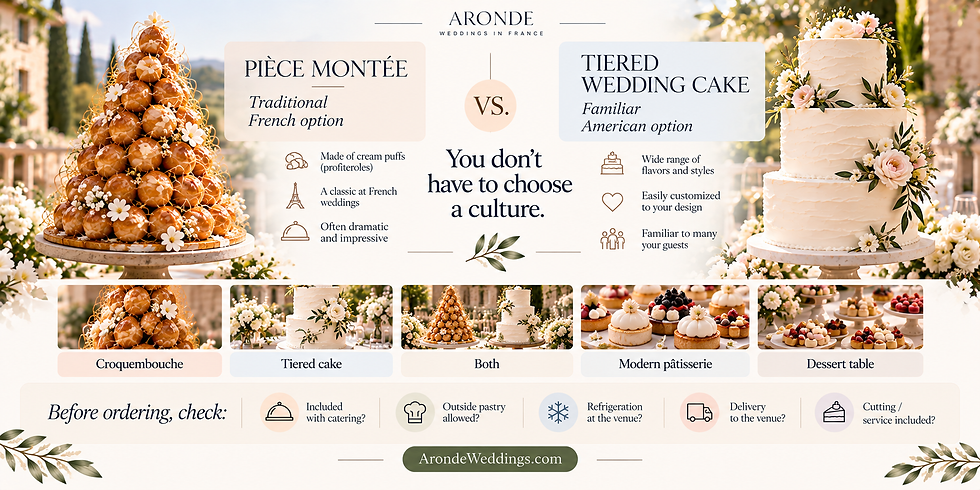
4. Croquembouche is traditional. A tiered wedding cake is not forbidden.
One of the most repeated differences between French and American weddings is also one of the easiest to oversimplify.
The traditional French pièce montée is often a croquembouche: a tower of cream-filled choux assembled with caramel, sometimes incorporating nougatine and other decorative elements. The broader French tradition of elaborate pièces montées dates back centuries, and choux-based pieces remain associated with weddings today.
But France does not have a croquembouche-or-nothing rule.
Contemporary French pastry professionals make tiered wedding cakes, naked cakes, entremets, macaron towers, dessert displays and modern versions of the traditional pièce montée. Current French wedding-market offerings include both croquembouche and American-influenced wedding cakes.
For an American couple, the useful question is therefore not which tradition you are “supposed” to choose.
It is who is responsible for dessert and what your catering agreement allows.
If dessert is included in your traiteur proposal, determine exactly what is included. If you want an outside cake designer, confirm whether the venue and caterer permit an outside dessert and who will receive, store, assemble, cut and serve it.
A summer château wedding introduces another practical issue: a beautiful cake that requires refrigeration needs suitable cold storage until it is served. Never assume that a historic venue's catering space has the same facilities you would expect from a purpose-built American ballroom or hotel.
Choose the dessert you actually want. Then make sure the logistics support it.
5. French wedding gifts are more nuanced than “no registry, just cash”
Another common comparison needs correcting.
France absolutely has a tradition of the liste de mariage, the French equivalent of a wedding registry. For many years, couples used wedding lists to select household items that guests could purchase for them.
What has changed is the way couples live before marriage. Contemporary French wedding sources describe traditional lists existing alongside increasingly common urnes and cagnottes — physical or online funds through which guests contribute money, often toward a honeymoon or another shared project.
Current French wedding guidance explicitly describes this shift rather than the disappearance of wedding lists.
For an American-French guest list, the interesting problem is not deciding which country has the “correct” etiquette.
It is making the gift process work internationally.
If you use a registry or cash fund, check whether American guests can access it easily, whether foreign cards work, whether currency conversion or international payment fees apply and whether the instructions make sense to someone unfamiliar with French wedding customs.
This is a small example of a much larger destination-wedding principle: something can be completely normal in France and still create friction for guests arriving from another country.
6. You may encounter dragées — but they are a tradition, not an obligation
Small sugar-coated almonds called dragées have traditionally been given to guests at French weddings and baptisms. Larousse still defines them as sweets commonly offered for those occasions, and French wedding coverage continues to identify them as a wedding tradition.
Modern couples are by no means required to use them. French weddings now include everything from local edible gifts to candles, personalized objects and no favors at all.
For an American couple, dragées are therefore best understood as an option rather than another item that suddenly needs to be added to the budget.
If you like the tradition, use it. If you would rather give guests Provençal olive oil, local honey, regional sweets or nothing at all, getting married in France does not require you to perform every French wedding custom you encounter during your research.
7. A French wedding can continue very late — but the venue decides whether yours can
It is reasonable to encounter French weddings where dancing continues well after midnight and sometimes into the early morning. Contemporary French wedding material includes late-night food around 1:00 a.m., and current vendor experiences document celebrations with dancing continuing until around 4:00 a.m.
What the evidence does not justify is turning this into a rule that “French weddings end at 4 or 5 a.m.” or claiming that American weddings universally end by midnight.
Neither is reliable enough for planning.
For your wedding, the relevant question is:
How late can this particular venue, with this particular contract and transportation plan, realistically operate?
A venue may allow guests to remain onsite but require outdoor amplified music to stop earlier. Dancing may need to move indoors. Staff hours may be limited. Your DJ or bar contract may end before the venue itself closes.
And then there is transportation.
A château can be only 20 minutes from the nearest hotel and still leave guests stranded if there is little late-night taxi availability. Rural France should not be planned around the assumption that guests can open an app at 2:30 a.m. and immediately find enough cars for 60 people.
Follow the entire chain:
Desired party end → music restrictions → staffing → accommodation locations → transportation availability → shuttle departures → actual end of the guest experience.
A 4:00 a.m. party is only an advantage if the rest of the wedding can support it.

If most guests will sleep away from the venue, decide where they will be concentrated before asking transportation companies for meaningful quotes.
[INTERNAL LINK → Wedding Guest Transportation in France]
8. A French destination wedding often makes more sense as a weekend than a single event
A multi-day celebration is not uniquely French, and it would be misleading to describe every French wedding as a wedding weekend.
But for Americans traveling to France, the economics and logistics of the trip change the equation.
Guests may spend hundreds or thousands of dollars, cross multiple time zones and devote several days to travel. A six-hour reception can therefore feel disproportionately short compared with the journey required to attend it.
France also has many venue types that can support a residential celebration: châteaux, domaines, vineyards, private hamlets, country estates and properties offering hébergement sur place, or accommodation onsite.
That creates the possibility of:
Friday: welcome dinner or drinksSaturday: weddingSunday: brunch or relaxed lunch
The important distinction is between a venue having accommodation and actually supporting the wedding weekend you imagine.
Suppose your wedding has 90 guests and the château sleeps 24.
That means 66 guests still need accommodation elsewhere.
Those guests need hotels or rentals, potentially several accommodation hubs, transportation to and from the wedding, and a plan for attending the following day's brunch. The property may technically have accommodation while still functioning operationally as a mostly off-site wedding.
Accommodation available ≠ everyone stays together.
If the residential wedding-weekend experience matters to you, compare venues by how many of your actual guests they can accommodate rather than filtering only for “accommodation onsite.”
[INTERNAL LINK → French Wedding Venues Where Guests Can Stay On-Site]
9. Some American wedding “defaults” become deliberate choices in France
American couples may arrive with a familiar sequence already in mind: bridesmaids and groomsmen, a first look, bridal-party entrance, first dance, parent dances, speeches, cake cutting, bouquet toss and send-off.
None of these is incompatible with a wedding in France.
In fact, French wedding culture has itself absorbed international influences. French coverage has specifically noted the adoption of American-style bridesmaids and groomsmen alongside changing attitudes toward older French traditions.
The difference is useful because it gives you permission to stop treating either culture as a rulebook.
Instead, ask what each ritual contributes.
If a father-daughter dance matters to you, keep it. If you have never understood why you need a bouquet toss, leave it out. If a long French dinner sounds wonderful but croquembouche does not, choose the dinner and order the cake you actually want.
An international wedding does not need to prove that it is sufficiently American or sufficiently French.
Understanding both sets of expectations simply allows you to make those choices intentionally.
10. The venue may make your wedding feel more “French” than any tradition does
This is ultimately the difference that can have the greatest effect on the wedding itself.
What changes when you marry in France may have less to do with croquembouche or dragées than with the physical and operational reality of the property you choose.
A centuries-old château may have restrictions on amplified music.
A rural domaine may make guest transportation essential. A historic property may have bedrooms with air conditioning while the getting-ready room or reception space has none. A venue may require a particular caterer, restrict candles, limit installation hours or have an indoor rain plan that holds fewer people than its outdoor wedding capacity.
These aren't cultural traditions. They are operational constraints.
And they create consequences elsewhere.
A venue that sleeps 60 of your 80 guests can support a very different wedding weekend from one that sleeps 15.
A property with a 1:00 a.m. music curfew creates a different reception from one where indoor dancing can continue later.
A château 45 minutes from a TGV station with coach access creates a different guest experience from a remote property reached by narrow rural roads.
This is why comparing French venues should go beyond architecture, capacity and price.
Ask:
What wedding will we have to build around this property?
That question reveals far more than whether the venue looks like the France you imagined.
Compare venues by the wedding each property actually allows you to create — including accommodation, transportation, catering, rain plan and restrictions.
[INTERNAL LINK → How to Choose a Wedding Venue in France]
French vs. American Weddings at a Glance
Wedding element | Familiar American expectation | What you may encounter in France | What actually needs deciding |
Legal ceremony | Ceremony and legal marriage may happen together | Legal French marriage is civil and normally takes place through the mairie | Legal marriage in France or symbolic ceremony? |
Cocktail period | Cocktail hour | Vin d’honneur, sometimes with a different guest structure | What exactly does the caterer's package include? |
Dinner | One portion of the reception | Potentially longer, multi-stage meal | When will dinner realistically finish? |
Dessert | Tiered wedding cake | Traditional pièce montée/croquembouche plus modern alternatives | What dessert do you want, and who handles it? |
Gifts | Registry is familiar | Liste de mariage, urne or cagnotte | Will your system work easily for international guests? |
Favors | Many possibilities | Traditional dragées remain an option | Is this a tradition you actually want? |
Dancing | Timing varies widely | Some French celebrations continue well into the night | What does your venue actually permit? |
Wedding weekend | Optional extension | Particularly practical for many destination weddings in France | Can the venue actually accommodate your group? |
Traditions | Familiar American sequence | French and increasingly international customs coexist | Which traditions matter to you? |
These are cultural and planning patterns, not rules. Contemporary weddings in both countries vary by region, family, religion, generation, venue and the couple themselves.

So should you plan an American wedding in France or a French one?
You don't need to choose.
Keep the traditions that mean something to you. Borrow the French ones you genuinely enjoy. Skip the ones neither of you cares about.
What deserves more attention are the differences that affect how the wedding actually works: the legal ceremony, catering structure, dinner timing, venue restrictions, accommodation and late-night transportation.
Those are the differences worth discovering before contracts are signed.
Croquembouche versus tiered cake is a preference.
Discovering that 60 guests will be staying across three hotels and need transportation after a reception ending at 3:00 a.m. is a planning decision.
Knowing the difference between the two is much more useful than trying to make your wedding “French enough.”
Related Planning Guides
Can Americans Legally Get Married in France?
How to Plan a Destination Wedding in France
How to Choose a Wedding Venue in France
Wedding Guest Transportation in France


