
How to Create a Great Guest Experience for a Destination Wedding in France
Updated: Oct 23

How to Improve the Destination Wedding Guest Experience in France
A destination wedding in France is rarely just one day.
Your ceremony may last thirty minutes, but for many guests the experience begins months earlier with a flight search and continues through several days of airports, trains, unfamiliar roads, hotels, wedding events and travel home.
That changes what “guest experience” means.
Beautiful flowers, a thoughtful welcome and an excellent dinner all contribute to the celebration.
But your guests are just as likely to remember whether they understood how to reach the château, whether transportation arrived when expected, whether their room was comfortable in July and whether they knew how to get home at the end of the night.
For a destination wedding, hospitality isn't simply about adding more.
A great guest experience is often about removing friction.
Your Wedding Experience Starts Before Your Guests Arrive in France

For a local wedding, an invitation may provide most of the information a guest needs. An international wedding creates decisions long before anyone reaches the venue.
Guests need to know which airport makes sense, whether they should take a train or rent a car, where they should stay, how many nights they need, which events they're invited to and how they will move between them.
Families may need childcare information, while guests who don't drive may need to know whether attending is realistically possible without a car.
Don't treat those questions as administrative details to solve later. They affect whether guests book the right flights, accommodation and transportation in the first place.
Think of communication as the first part of the wedding experience.
Plan the Guest Journey — Not Just the Wedding Timeline

Most wedding timelines begin on the wedding morning. For a destination wedding, that's far too late.
Map the experience from the guest's perspective:
SAVE THE DATE → TRAVEL PLANNING → ARRIVAL IN FRANCE → ACCOMMODATION → WELCOME → WEDDING DAY → LATE-NIGHT RETURN → FAREWELL → TRAVEL HOME OR EXTEND THE TRIP
At each stage, identify what guests need to know or decide before they can move comfortably to the next one.
If they need to reserve a rental car, they need to know before arriving at the airport. If you're providing wedding shuttles, they need to know before choosing accommodation. If
Sunday's farewell brunch is important, they need to know before booking a Sunday-morning train.
The dependency is simple:
Wedding plans → guest information → guest bookings → workable logistics.
Don't Try to Entertain Everyone for Three Days
A destination wedding gives you more time with the people you love. It doesn't require you to fill every hour of their trip.
A simple three-day structure can already create a complete wedding weekend: guests arrive and join an informal welcome gathering on the first evening, attend the wedding the following day, then have an optional farewell breakfast or brunch before departures.
You can add a wine tasting, boat trip, market visit or group dinner if it genuinely improves the experience. But every additional organized event also creates another schedule, reservation, transportation problem and potentially another expense for either you or your guests.
Give guests options, not obligations.
They traveled to celebrate with you, but they also traveled to France. Leave some space for them to experience it.
Treat Arrival Day Differently
Arrival day is particularly important when guests are traveling from the United States.
A morning landing doesn't mean a guest is ready for an event two hours later. Immigration, baggage collection, a train connection or rental car, unfamiliar roads and another journey to the wedding region can consume much of the day.
Hotel or château check-in may also be later than the guest's arrival. Then there is jet lag.
If an event matters to you, don't schedule it so tightly against expected international arrivals that a delayed flight or missed train means guests miss it entirely.
Where possible, encourage important guests to arrive in the region before your main wedding events begin.
This isn't wasted time in the itinerary. It's a buffer protecting the rest of the weekend.
A Welcome Event Doesn't Need to Become a Second Wedding

A welcome gathering can be one of the most valuable parts of a destination wedding because it gives guests a chance to reconnect, orient themselves and settle into the weekend before the formal celebration begins.
It doesn't need the production level of another reception. Depending on the venue and destination, an apéro in the courtyard, relaxed restaurant dinner, wine and cheese, pizza night, garden gathering or drinks by the pool may do the job perfectly well.
The practical question isn't “How impressive should our welcome event be?” It is what purpose does it serve?
If the answer is giving people time to meet, reconnect and understand where they are, design it around that purpose. Guests arriving after an overnight flight may appreciate an easy evening and an early night more than another five-hour event.
Where Your Guests Stay Changes the Entire Wedding

Accommodation is not separate from wedding logistics simply because guests are paying for their own rooms.
Start with your venue. How many people can realistically stay there, and who should those rooms go to? If the property cannot accommodate everyone, the location of the remaining guests will determine transportation routes, pickup points and how easily people can participate in the weekend.
This is why a list of the prettiest hotels nearby isn't enough.
A charming stone guesthouse 25 minutes from your château may look ideal online.
If it has no late check-in, no effective cooling in summer and no realistic transportation back from the wedding at 1:30 a.m., it may be a poor recommendation for your guests.
For each accommodation option, consider the features that affect the actual trip: distance from the venue, transportation, parking, check-in and late access, breakfast, air conditioning, stairs or elevators, accessibility and family rooms.
Where possible, grouping guests into one or two accommodation hubs can simplify everything that comes next.
Accommodation locations → pickup points → shuttle routes → transportation quote.
Transportation Can Make or Break the Guest Experience

Transportation deserves more attention at a destination wedding in France than many couples initially expect, particularly when the celebration takes place at a château, vineyard or rural estate.
The important question isn't whether a taxi or ride-hailing service technically operates somewhere in the region. It's whether the transportation plan works for your actual number of guests, locations and schedule.
A few daytime cars being available doesn't mean 40 guests can reliably leave a rural château after midnight.
Map the movements that matter: airport or station to accommodation where relevant, hotel to wedding venue, movement between separate ceremony and reception locations, and the return journey after the party.
Then think about different departure times. Your friends may happily dance until 2:00 a.m.; grandparents and families with young children may want to leave hours earlier.
One final shuttle can technically solve transportation while still producing a poor guest experience.
Research transportation early, but don't finalize routes until you know where guests are staying.
If Guests Are Renting Cars, Don't Assume They Drive Manual
For American guests, renting a car in France can involve one easily overlooked detail: transmission.
French rental fleets include both manual and automatic cars, and rental companies allow customers to select automatic categories specifically. If a guest only drives automatic, they should check the transmission when booking rather than assume the car assigned at pickup will be automatic.
Some rental categories also offer fewer automatic options than others.
For a wedding during a busy travel period, reserving the required transmission in advance is much safer than arriving at the rental counter and hoping an appropriate car is available.
Guests should also look at luggage capacity rather than passenger capacity alone.
A compact car that technically seats four people may be much less practical once it needs to hold suitcases, formalwear and several days of luggage.
This matters particularly when guests will be driving to rural venues. A rental car isn't useful if the person collecting it isn't comfortable driving it.
Don’t Assume the Rental Car Desk Will Be Open When You Arrive
American travelers may be used to major airport rental car locations operating very long hours, sometimes around the clock. In France, opening hours can be much more limited and can vary significantly by location.
A rental office may open later in the morning, close in the early evening, have reduced weekend or public-holiday hours, or close for part of the day. Even at major airports, a late flight does not automatically mean that the rental desk will still be open when you arrive.
Before booking a flight and rental car separately, check the opening hours of the exact pickup location for your arrival day — not just the rental company's general airport information.
Also check what happens if your flight is delayed beyond closing time. Providing your flight number may help the rental company track a delay, but guests should not assume that someone will automatically stay after hours.
This matters even more for a wedding in rural France. If your plan is flight → rental car → château, discovering at 11:00 p.m. that the rental desk has closed can leave you without the transportation you were relying on to reach your accommodation.
Late arrival? Consider spending the first night near the airport and collecting the car the following morning if the pickup hours make the connection risky.
Let France Provide Some of the Entertainment

You don't need to manufacture three days of activities when your guests have traveled to a destination worth exploring.
What makes sense depends on the region.
In Provence, guests might explore village markets, wineries and nearby towns.
On the French Riviera, a free afternoon could mean the beach or a coastal town.
Bordeaux naturally creates opportunities around vineyards and the city, while the Loire Valley can combine château visits, gardens, cycling and wine.
Dordogne offers a different experience again, with medieval towns, markets, countryside and river activities.
Lake Annecy and the Alps can make the destination itself part of the trip without requiring you to organize a formal excursion.
The important distinction is between providing information and hosting an activity.
A carefully curated page on your wedding website may be enough. Tell guests what is nearby, what genuinely deserves their limited time and what needs advance booking. You don't have to become everyone's tour operator.
Walk Through the Wedding as a Guest
When visiting a venue, couples naturally focus on the ceremony backdrop, dinner setting and photographs. Walk through it once without looking at any of those things.
Imagine arriving as a guest who has never been there.
Where do you get dropped off?
Is it obvious where to go? Is there somewhere to sit before the ceremony?
Is there shade and water? How far is the walk to cocktail hour?
Where are the bathrooms? What happens after sunset?
What does the ground feel like in formal shoes?
Then follow the route all the way to the end:
Arrival → Ceremony → Cocktails → Dinner → Bathrooms → Dancing → Shuttle or Bedroom
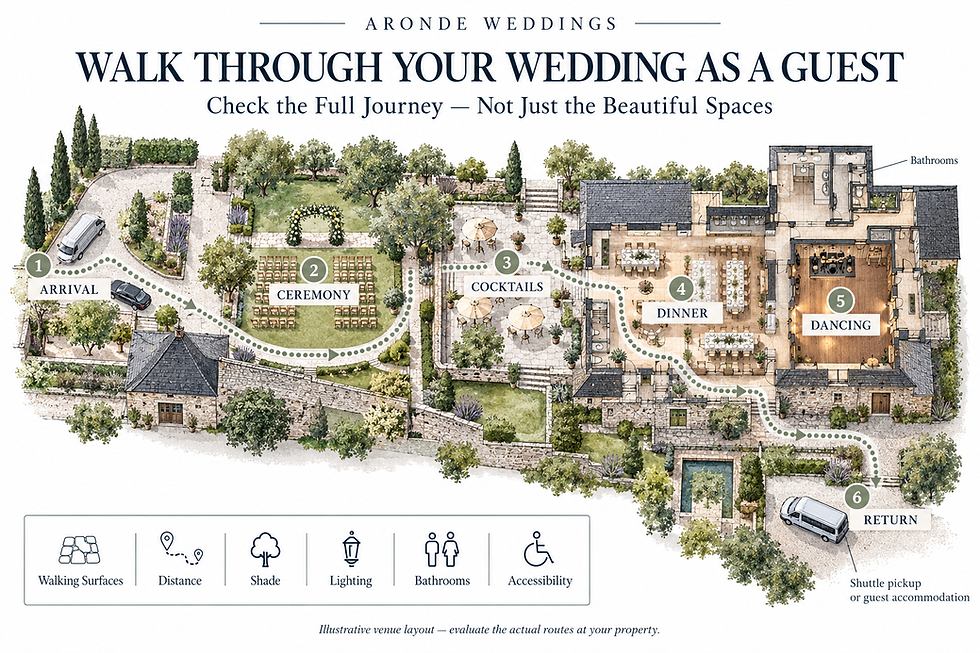
Now walk the same route mentally in rain, after dark and from the perspective of someone with limited mobility.
A property can photograph beautifully while creating a surprisingly difficult guest journey.
France Is Beautiful. It Isn't Always Climate-Controlled.

Historic French properties weren't necessarily designed around modern expectations for air conditioning. A venue listing that mentions AC also doesn't tell you which spaces are actually cooled.
Guest bedrooms may have air conditioning while the getting-ready room doesn't. Some rooms may be cooled while others aren't. The indoor reception space may have a completely different setup.
For a summer wedding, establish where guests will actually spend time: bedrooms, getting-ready rooms, ceremony, cocktail hour, dinner and dancing. Then determine where cooling, shade and drinking water will be available.
If the venue doesn't provide sufficient cooling for the spaces you plan to use, that decision can create another supplier requirement rather than simply a comfort issue.
Venue cooling limitations → spaces affected → temporary cooling requirements → electrical requirements → additional vendor and cost.
Your Weather Plan Is Also a Guest Plan
A rain plan isn't successful simply because the ceremony can technically continue indoors.
Ask what the change does to the guest experience.
Does the indoor room hold the full seated guest count?
Can people move between buildings without crossing wet lawns or gravel?
Does dinner still work? Is there room for dancing once everyone is inside?
Heat creates a similar problem. A ceremony may be possible in full sun, but that doesn't mean asking guests — particularly children and older relatives — to sit there for an extended period is sensible. The same applies when temperatures fall after sunset.
The useful standard isn't simply “Can the wedding continue?”
It is “Can the wedding still work comfortably for the people attending it?”
Accessibility Is a Journey, Not an Amenity

Asking whether a château is “accessible” doesn't tell you enough.
Historic properties can combine stairs, gravel, lawns, cobblestones, uneven floors, long distances between spaces and buildings without elevators.
A venue may have an accessible reception room while the actual route your guests need to follow is much more difficult.
Trace the complete experience:
Drop-off → Ceremony → Cocktails → Dinner → Bathrooms → Dancing → Accommodation or Transportation
This matters beyond wheelchair access. Older relatives, pregnant guests, people recovering from injuries, guests with temporary mobility limitations and parents moving around with small children can all experience the property differently.
The question is not simply whether the venue is accessible. It's whether the wedding you are designing inside that venue works for the guests who will actually attend it.
Children Change More Than the Guest Count

If children are invited, think beyond adding children's meals to the caterer's numbers.
A destination wedding may run from late afternoon until well after midnight.
Parents need to understand what happens during that entire period.
Where can children eat? Is there somewhere quiet?
Are high chairs available? Is the pool accessible during wedding events?
Can a sleeping child be taken back to a bedroom without removing the parent from the entire celebration?
For weddings with several families, professional childcare may change the experience significantly. Instead of parents repeatedly leaving dinner or the party, a dedicated childcare arrangement can provide supervision and a quieter environment nearby.
But don't hire childcare simply because destination weddings sometimes provide nannies. First understand the ages and number of children attending, where they will be staying, the wedding schedule and what their parents actually need. Those answers determine whether professional childcare would solve a real problem.
If your wedding is adults-only, the same principle applies in another way: communicate the decision early. International guests may need considerably more time to arrange childcare than someone attending a wedding near home.
Food Is Part of the Destination Experience — and the Logistics
French food doesn't need to become a theme. It is already part of the destination.
Regional wine, bread, cheese, seasonal produce, an apéro or pastries the following morning can make France present without turning every meal into a formal gastronomic event.
But think beyond the wedding menu.
Guests arriving late at rural accommodation may discover that there is nowhere nearby to eat. Restaurant hours may not match what they expect from home, and Sunday or public-holiday availability can vary considerably by location.
A short, verified list of useful nearby restaurants, bakeries, grocery stores and opening hours may therefore improve the guest experience more than an elaborate welcome gift.
Information is hospitality too.
Be Clear About What You're Hosting — and What Guests Are Paying For
Destination weddings already ask guests to spend money on travel, accommodation and time away from home. That doesn't mean the couple has to pay for every part of the trip.
It does mean guests shouldn't have to guess.
If you're formally hosting a welcome dinner, brunch or other event, make the arrangement clear. If you're organizing an optional wine tasting, boat trip or other activity that guests will pay for themselves, tell them the cost before they commit.
Personal travel — flights, additional vacation nights and independent activities — can remain separate from hosted wedding events.
The important principle isn't a universal rule about who pays. It's clarity before the guest makes a financial commitment.
Don't Forget the End of the Night

Couples spend a great deal of time planning how guests arrive at a wedding.
The exit deserves the same attention.
At midnight or 2:00 a.m., your guests may be tired, unfamiliar with the area and several miles from their accommodation.
That is a poor moment for them to discover that taxis aren't readily available or that they don't know where the shuttle pickup point is.
Build the return plan around actual behavior. If some guests will leave earlier, consider whether an earlier shuttle makes sense. Communicate pickup locations and departure times clearly, and decide who guests can contact if something goes wrong.
Also consider what they encounter when they return. In rural areas, late-night food may be limited, and a guest arriving back at accommodation shouldn't have to start solving basic logistics at 1:30 in the morning.
The final twenty minutes of the evening are still part of the wedding experience.
The Morning After Doesn't Need Another Production

A farewell brunch can be valuable because it gives people one more chance to reconnect before everyone starts moving in different directions.
It doesn't have to resemble another reception.
Coffee and croissants at the château, breakfast by the pool, a village café or an informal meeting point may be enough. Some guests will have early trains or flights; others will be exhausted; some will happily stay for hours.
Keep the format flexible unless the event itself is an important part of your wedding weekend.
Help Guests Experience France Without Planning Their Vacation
Some guests will extend their trip before or after the wedding. Give them a useful starting point without trying to build a complete French itinerary for everyone.
Your wedding website can highlight a handful of genuinely useful places: a nearby village worth visiting, restaurants you actually recommend, a market, winery, swimming spot or easy excursion.
Explain what requires reservations and include practical information such as the nearest pharmacy, supermarket, train station or reliable local transportation option where useful.
For destination weddings, curation beats volume.
Five recommendations that make sense geographically and logistically are more useful than fifty attractions copied from a tourism website.
Your Wedding Website Is Part of the Guest Experience
For a destination wedding, the website shouldn't function only as an RSVP page. It can become the central reference point for the trip.
Organize information around the decisions guests actually need to make: how to reach the region, where to stay, whether they need a car, what transportation you're providing, when events happen, what to wear, whether children are invited and what guests need to reserve independently.
Then add practical information as plans become firm: weather expectations, footwear where terrain matters, local activities, restaurants, hosted versus self-paid events and useful contacts.
Update the site as decisions change. Every important question answered there is one less problem a guest has to solve while traveling.
Small Things American Guests May Not Expect in France
Some of the most useful information you can give American guests has little to do with weddings. These details don't require a long explanation on the invitation, but they're ideal for a practical section of your wedding website or guest guide.
Bring a Little Euro Cash — but Check the Exchange Rate First
Guests don't need to arrive carrying a large amount of cash, but having some euros available can make the first day easier — particularly for small purchases or situations where card payment isn't convenient.
If you want to arrive with some cash already in your wallet, check with your U.S. bank before the trip. Foreign currency may need to be ordered several days in advance, so this is something to arrange well before departure.
Several major American banks allow existing checking or savings customers to order foreign currency before traveling. Depending on the bank, euros may be ordered online or through a mobile app for branch pickup or home delivery; other banks require the order to be placed at a branch.
Ordering euros before departure is primarily about convenience, not a guarantee of getting the best exchange rate. Banks set their own exchange rates and may charge fees, so compare the actual cost rather than assuming that exchanging money in the United States will always be cheaper.
There is another practical reason not to leave everything until arrival. If your flight lands late in the evening, airport currency exchange counters may already be closed. Once you travel beyond major tourist areas, finding a convenient currency exchange office can also become more difficult, particularly in smaller towns.
A little cash can come in handy later in the trip, too. Cards are widely used in France, but you may come across a small market stall, brocante, local producer or other independent seller where cash is easier — or occasionally the only practical option. It would be a shame to discover the perfect little keepsake from your wedding trip and have to leave it behind simply because you have no euros with you.
If your bank offers a choice of denominations, ask for at least some smaller notes. They're generally more practical for everyday purchases than carrying most of your cash in large bills.
Don't Rely on One American Credit Card
Card payment is widespread in France, but guests shouldn't assume every U.S. card network will be accepted by every merchant.
Visa and Mastercard are useful primary cards to carry. American Express is accepted by some French businesses — including major institutions — but not universally, so guests who normally rely on Amex should carry a Visa or Mastercard backup. Discover can be used internationally where its network is supported, but Discover itself recommends checking acceptance for the destination rather than assuming universal coverage.
Guests should also check their own card's foreign-transaction fees and payment limits before traveling.
If a payment terminal or ATM offers to convert the transaction into U.S. dollars, look carefully at the conversion being offered rather than automatically accepting it.
Visa explains that dynamic currency conversion must show the local-currency amount, cardholder-currency amount, exchange rate and applicable markup, and the customer can decline the conversion.
Electricity Is Different
France uses a different electrical system from the United States. A plug adapter changes the physical connection; it doesn't necessarily make an American appliance electrically compatible.
Guests should check the voltage requirements of devices before using them, particularly heat-producing appliances such as hair dryers, curling irons, straighteners and steamers.
Air Conditioning Shouldn't Be Assumed
Historic hotels, châteaux, villas and rural accommodations may not provide the level of cooling an American traveler expects.
If you're recommending accommodation for a summer wedding, don't simply look for an AC icon on the booking page. Confirm which rooms are cooled and, where relevant, whether common areas are comfortable during hot weather.
Uber Isn't a Universal Transportation Plan
Ride-hailing may be easy in major cities and much less useful around rural estates and villages, particularly late at night.
A service being available somewhere in a region doesn't mean it can move dozens of wedding guests from a château after midnight.
Sunday and Holiday Opening Can Be Different
Don't tell guests simply that “everything in France closes on Sunday” — that isn't universally true.
Opening patterns depend on the location, type of business and date. Instead, verify the businesses guests are actually likely to need around your wedding: supermarkets, pharmacies, restaurants and other essentials.
Late-Night Food May Be Limited
Particularly in rural areas, guests shouldn't assume they'll easily find food after a late arrival or after returning from the wedding.
If this could affect your group, include realistic late-arrival options on your wedding website rather than leaving guests to search after they arrive.
Historic Charm Can Come With Stairs
Beautiful old properties may have no elevator, narrow staircases, uneven floors, gravel paths or considerable distances between rooms.
That information matters when guests choose accommodation, pack luggage and decide what shoes to wear.
Small surprises become much more noticeable when someone is tired, jet-lagged and navigating another country.
Think About Real Guests — Not an “Average Guest”
There is no average wedding guest.
A group of friends in their twenties may happily rent cars, stay in rural accommodation and dance until 2:00 a.m. Your grandparents may need a short route between their room and the reception.
A family with a toddler has another set of constraints. Someone visiting Europe for the first time may need more guidance than a guest who travels to France regularly.
You don't need to eliminate every possible inconvenience. Instead, identify the few situations in your actual guest list that materially change the plan.
For example, one guest with limited mobility may change which bedroom you assign them and where their transportation drops them off. Fifteen children may make professional childcare worth investigating. Twenty guests who won't drive can fundamentally change your transportation plan.
Guest characteristics → practical need → wedding decision.
That's much more useful than designing for an imaginary average attendee.
Don't Confuse More With Better
Destination wedding weekends can expand surprisingly quickly. A welcome dinner becomes a brunch, then a wine tasting, then a boat day, another dinner, welcome bags and transportation for all of it.
Every individual idea may be appealing. Together they can produce a weekend that costs more, requires considerably more coordination and leaves guests with very little time to enjoy the destination independently.
Before adding another event or service, ask one useful question:
What problem does this solve, or what meaningful experience does it create?
If you have a clear answer, it may deserve a place in the weekend. If you're adding it because a destination wedding seems “supposed” to include it, it probably deserves another look.
The Best Wedding Weekends Have Rhythm
A successful destination wedding doesn't need constant activity.
There should be moments of arrival, connection, anticipation, celebration, recovery and farewell. Some will be planned; others shouldn't be.
A coffee in the château kitchen, an afternoon with nothing scheduled, a walk into the village or an unexpected bottle of wine with friends can become part of the experience precisely because nobody put it on an itinerary.
Don't schedule those moments out of existence.
Before You Finalize the Wedding Weekend
Instead of reviewing another generic checklist, run the weekend through seven high-impact tests.
Can guests realistically reach the wedding?
Not merely whether Google Maps shows a route. Consider the actual airports or stations they'll use, the final transfer and whether guests who don't want to drive have another workable option.
Does accommodation support the transportation plan?
If guests are scattered across several towns or villages, determine what that does to shuttle routes before assuming transportation will be simple.
Have you protected important events from international travel disruption?
Allow enough margin for flights, transfers, check-in and jet lag before events you genuinely don't want guests to miss.
Does the venue remain comfortable when conditions aren't ideal?
Test heat, rain, shade, bathrooms, walking surfaces, accessibility and the full-capacity Plan B rather than judging comfort from the best-weather version of the venue.
Do families, older guests and non-drivers have a workable version of the weekend?
You don't need to design everything around them, but important needs should be identified before the schedule is fixed.
Does everyone understand what you're paying for and what they're paying for?Communicate hosted and optional paid events before guests make reservations.
How does everyone get home after the party?
Have a real answer before the wedding day.
If one of these questions exposes a problem, solve the dependency behind it rather than simply adding another line to the wedding website.
Some Guest-Experience Problems Need Specialist Vendors
Not every destination wedding needs the same support team.
Once the venue, guest list and schedule are more developed, you may discover needs that weren't obvious when you first started hiring vendors.
A château without adequate cooling may require temporary climate equipment.
Limited facilities can create a need for additional toilets. A large number of children may make professional wedding childcare useful.
An international guest list may benefit from an English-speaking or bilingual MC, while complicated production can require additional power, lighting or technical support.
Other weddings may benefit from vendors whose purpose is less operational but still connected to the experience: a live painter, guest illustrator, children's entertainer or musician may make sense because of the particular format you've chosen.
The important distinction is that these aren't services to add simply because they sound impressive. Some solve infrastructure or guest problems; others create an experience you've deliberately decided is worth adding.
Venue + guest list + wedding format → practical or experiential need → specialist vendor.
You May Need Vendors That Aren't on the Usual Wedding Checklist
The photographer, florist, caterer and DJ are easy to remember. Temporary cooling, additional toilets, generators, childcare, bilingual MCs and specialist production suppliers are much easier to discover only after another decision has already been made.
Understanding those dependencies early can protect both the wedding experience and the budget.
Create an Experience That Feels Easy
Your guests probably won't remember whether a welcome bag contained three items or five. They may never notice some of the decorative details that took weeks to choose.
They will notice whether the trip made sense.
They will remember whether they knew where to go, whether they could get back after the party, whether they were comfortable, whether there was enough time to enjoy France and whether they felt looked after without feeling managed.
That's the goal of destination-wedding guest experience: not to anticipate every possible desire or fill every hour with entertainment, but to remove enough friction that your guests — and you — have room to enjoy why everyone came to France in the first place.
Keep Planning Your Wedding in France
How to Plan a Destination Wedding in France
Build your wedding in the right dependency order, from guest count and budget through venue, vendors and wedding-weekend logistics.
How to Choose a Wedding Venue in France
Evaluate accommodation, transportation, climate, accessibility, Plan B and infrastructure alongside the spaces themselves.
Wedding Guest Transportation in France
Plan airport and station arrivals, accommodation pickups, wedding-day shuttles and late-night returns.
Where Should Wedding Guests Stay in France?
Choose accommodation based not only on the hotel itself, but on how its location affects transportation and the rest of the wedding weekend.


