
How to Choose a Wedding Photographer in France
Updated: Oct 25

Choosing a wedding photographer is difficult for one simple reason: almost every experienced photographer can show you beautiful photographs.
Your job is not to find out whether someone has ever taken a beautiful picture. It is to work out what your wedding is likely to look like through that photographer’s eyes — from the quiet part of the morning to bright afternoon sun, from portraits of the two of you to photographs of your parents and friends, and from a candlelit dinner to a dark dance floor.
That requires looking beyond Instagram, beyond a photographer’s best twenty images, and sometimes beyond broad labels such as “editorial,” “documentary” or “fine art.”
The photographer who is right for you does not necessarily have to be exceptional at every type of wedding photograph. Their strengths need to align with the parts of the wedding you most want to remember.
Start With What You Actually Want From Your Photographs
Before comparing photographers, decide what matters most to you.
Imagine that only three parts of your wedding photography could be truly exceptional. Which would you choose?
Perhaps it is the two of you: portraits, movement, expressions and the quieter moments between you. Perhaps your wedding is primarily about bringing family and friends together in France, and photographs of those relationships matter more than an elaborate portrait session.
You might care most about atmosphere — movement, emotion, light and the feeling of being there. Or perhaps you chose a château in the Loire Valley, a Provençal mas or a property overlooking the Mediterranean partly because of the place itself, and you want the architecture and landscape to become an important part of the photographic story.
Other priorities might be fashion and details, or the energy of dinner, speeches and dancing.
There is no correct hierarchy.
A photographer might create extraordinary photographs of couples but fairly conventional group portraits. If family formals are something you want documented rather than something you expect to become a major part of your album, that may be completely acceptable.
Another photographer may be exceptional at capturing guests: a parent’s expression during the ceremony, conversations at cocktail hour, children playing, reactions during speeches.
If gathering your people together is one of the reasons you are having a destination wedding, that strength may matter much more.
Do not look for a photographer without weaknesses. Look for a photographer whose strengths are concentrated in the places that matter to you.
When Should You Book a Wedding Photographer in France?
Once your venue and wedding date are confirmed, photography is worth researching early.
There is no universal booking deadline because photographers control their own calendars and may accept very different numbers of weddings each year.
If photography is one of your highest priorities, starting around 12–18 months ahead gives you a useful planning window, particularly if you have a specific photographer in mind or are planning a popular Saturday date.
Treat that as a planning window rather than a rule. If your wedding is six months away — or even closer — it is still worth contacting photographers you like. Availability varies by photographer, date and season.
If you are still working out what needs to be secured first, our destination wedding timeline in France puts photography into the larger sequence of venue and vendor decisions.
And if you find a photographer whose work feels unusually right, check availability before spending days analyzing every gallery they have ever photographed.
How to Choose a Wedding Photographer in France: What to Look for in Their Portfolio
A portfolio is a selection, not a neutral sample of everything a photographer produces.
Start by noticing what the photographer chooses to show you.
Are there mostly portraits of couples?
Do you see parents and grandparents?
Are guests present throughout the story?
Is the venue itself photographed?
Are there photographs of flowers, stationery, clothing and tables?
What happens once dinner begins?
Also notice what consistently makes you stop.
It may be the photographer’s composition rather than their editing. Perhaps you love how close they get to people, or the opposite — how they place a couple within architecture or landscape.
You may respond to movement rather than posed portraits, strong color rather than muted tones, or photographs that feel quiet rather than energetic.
For example, these three photographs show how different editing styles can transform the mood of wedding images — from bright and airy to warm, film-inspired tones and bold, high-contrast photography. When reviewing portfolios, consider which style feels most like you.

Broad style labels can help you start a search, but the photographs themselves tell you much more.
These two images illustrate the difference between documentary and editorial wedding photography. Documentary captures spontaneous, unposed moments, while editorial uses intentional posing and composition to create a more polished, fashion-inspired look.


Don’t Judge a Photographer by Their Best Photographs
Once you have a shortlist, ask to see complete wedding galleries.
A website or Instagram account tells you what a photographer considers portfolio-worthy. A full gallery tells you what happens during the rest of the day.
Follow the wedding from beginning to end:
getting ready → ceremony → family photographs → couple portraits → cocktail hour → dinner → speeches → dancing.
You are looking for consistency, but that does not mean every photograph needs to be spectacular. No wedding contains eight uninterrupted hours of portfolio images.
Instead, ask whether the quality and visual approach hold together when circumstances become less controllable.
What happens when the photographer moves from a beautiful window-lit room to an outdoor ceremony, then into a dark reception space?
What happens when they photograph people who are not the couple?
What happens when moments cannot be posed or repeated?
A full gallery answers a much more useful question: Can I imagine being happy if this were my complete wedding gallery, rather than simply wishing I had its best ten photographs?


Classic Portrait vs Movement Portrait vs Editorial Portrait
Ask to See a Wedding That Actually Resembles Yours
A full gallery becomes considerably more useful when the wedding shares some conditions with yours.
If you are planning an outdoor ceremony followed by a candlelit dinner inside a stone château, a gallery from an entirely outdoor summer wedding does not tell you everything you need to know.
Likewise, if you are marrying on the French Riviera and much of the day will happen outside, you need to know how the photographer handles strong Mediterranean daylight — not only what their portraits look like during golden hour.
For a winter wedding in Paris, look for substantial indoor and after-dark coverage. For a rural château celebration, look at how the photographer handles both the grounds and darker historic interiors.
The venue does not have to be the same. The photographic conditions are often more revealing than whether the photographer has worked at your exact property before.
A full gallery shows consistency. A relevant full gallery shows consistency under conditions closer to the ones you are actually planning.
Look at What Happens When the Light Changes

This is one of the easiest things to miss when choosing a wedding photographer.
A photographer’s work can change substantially as the light changes.
Someone may produce beautiful, subtle photographs using natural light but have a much less distinctive approach once the reception moves indoors and daylight disappears.
Another photographer may be at their best after dark, using flash or other artificial light to create bold, dramatic photographs, while their daytime work feels comparatively simple to you.
Neither approach is automatically better.
So do not ask only:
Can you photograph in low light?
Look at what the photographer’s work becomes in low light.
When reviewing galleries, look for photographs made in several different conditions:
strong daylight;
open shade;
window-lit interiors;
sunset and blue hour;
dim dinner spaces;
speeches after dark;
dancing and fast movement under artificial light.
Pay attention to whether you like the photographer’s work in each of those situations — and how important each situation will be at your wedding.
If your ceremony is outside at 4 p.m. in Provence, do not evaluate the photographer only by sunset portraits.
Natural light is not automatically easy or flattering light; strong summer sun creates very different conditions from the soft light photographers often feature in portfolios.
At the other end of the day, if dinner begins after sunset and dancing continues until 2 a.m., a substantial part of your photographic story will happen without daylight.
Three Ways to Photograph a Wedding After Dark
Nighttime wedding photography can look dramatically different depending on how a photographer uses light. These three examples show how candlelight, direct flash, and creative motion techniques can capture very different moods — from intimate dinner conversations to the energy of the dance floor.
Candlelight Photography — Warm, atmospheric images that preserve the intimacy of an evening reception.
Direct Flash Photography — Sharp, high-contrast photographs that capture spontaneous expressions and lively party moments.
Motion & Flash Photography — Creative images combining sharp subjects with movement and light trails to convey the energy of dancing.
As you review photographers' galleries, consider which of these approaches you would most enjoy seeing in your own wedding album.

Candlelight Photography 
Direct Flash Photography 
Motion & Flash Photography
You Don’t Have to Value Every Part of the Gallery Equally
Suppose you find a photographer whose couple portraits make you want to stop scrolling, whose photographs capture movement and emotion exactly as you hope to remember them — but whose formal family groups feel fairly ordinary.
That is not automatically a reason to eliminate them.
If you expect to spend a few minutes taking necessary family photographs and rarely care about formal groups, that photographer’s weakness may have little effect on your decision.
For another couple, family photography may be central.
Perhaps grandparents are traveling internationally, several generations rarely gather together, or the wedding is one of very few occasions when everyone will be in the same place. In that case, the same portfolio deserves a different evaluation.
Apply the same thinking to guests, details, architecture and reception photography.
The question is not:
Is this photographer equally good at everything?
It is:
Are they particularly good at the things we care about most?
Look at How They Photograph People Other Than the Couple
Couple portraits are relatively easy to find in a portfolio because photographers naturally select them for websites and social media. Spend time looking at everyone else.

Do parents appear only during formal photographs, or do you see their reactions throughout the day?
Are guests photographed interacting naturally?
Are there photographs of friendships, children, grandparents and conversations that the couple may not even have witnessed?
Look at formal groups too, even if they are not a priority. Are people arranged clearly?
Do the photographs feel unnecessarily stiff?
Can the photographer handle a large family group as competently as two people standing in beautiful light?
This can matter particularly at a destination wedding. Bringing people from different places together in France may be one of the rarest parts of the celebration.
Your gallery may eventually show you moments involving those people that you never saw on the wedding day.
Look at How the Photographer Sees the Place
If you have spent months finding the right venue in France, decide how much you want that place to exist in your photographs.
Some photographers are intensely people-focused. Others regularly step back and use architecture, landscape, interiors and the relationship between people and place as part of the story.

Environment-Focused Wedding Photography 
People-Focused Wedding Photography
Again, neither approach is inherently superior.
But if the reason you chose a Loire château includes its formal gardens and rooms, or the reason you chose Provence includes the stone, landscape and outdoor dinner setting, make sure those elements exist in the photographer’s work.
Look at details too. If flowers, fashion, stationery or the tablescape matter to you, see whether the photographer treats them as meaningful parts of the day or simply records them.


If you are still comparing properties, how you choose a wedding venue in France can affect photography in ways that go beyond aesthetics: indoor alternatives, room layout, outdoor spaces and the practical flow of the day all determine what the photographer will actually have to work with.
The same applies to bad weather. If the ceremony, portraits and cocktail hour are planned outside, evaluate the venue’s rain plan before assuming the photographs will simply move indoors. The backup space may have completely different light, architecture and room to work.
Decide How Much Direction You Want
Two photographers can create equally accomplished work while behaving very differently around the couple.
One may give substantial direction: where to stand, how to move, where to place your hands, where to look and when to walk. Another may intervene very little and wait for moments to develop naturally.
Many photographers work somewhere between those extremes.
If you dislike being photographed, “documentary” may initially sound safer because it suggests less posing. But you may actually appreciate clear direction during portraits because it removes the pressure of figuring out what to do.
Conversely, if you want most of the day to unfold without interruption, a photographer who frequently creates and directs scenes may frustrate you even if you love the resulting images.
When you speak, ask the photographer to describe what actually happens during a portrait session. Their answer is more useful than a style label.
Could Two Different Photographers Cover Different Parts of the Wedding?
It is possible, and for some couples it can solve a very specific problem.
You might love one photographer’s soft natural-light storytelling for the wedding morning, ceremony and portraits, while another photographer creates exactly the dramatic flash photography you want for dinner and dancing.
If both aesthetics matter strongly to you, you can explore hiring different independent photographers for different portions of the day.
The trade-off is visual continuity.
Different photographers may make different choices about composition, color, contrast, movement, flash and editing. Your afternoon photographs could feel quiet and romantic while your reception photographs become darker, bolder and more energetic.
That difference may be exactly what you want.
Or it may bother you if you imagine the wedding as one cohesive visual story.
Before booking this arrangement, tell both photographers exactly how coverage will be divided, whether their working times will overlap, and review both contracts to make sure another photographer is permitted.
This is also different from hiring a second photographer as part of one photography team.
Do You Need a Second Photographer?
A second photographer is not simply an assistant.
An assistant may help with equipment, lighting and logistics behind the scenes.
A second photographer is typically hired to photograph the wedding alongside the primary photographer, allowing the team to cover moments or locations that one person cannot capture simultaneously.
Rather than deciding based on an arbitrary guest-count rule, look at simultaneous events.
If both partners are getting ready in different locations, one photographer cannot photograph both at the same moment. During couple portraits, a second photographer may remain with guests at cocktail hour. During a ceremony or speech, two photographers can concentrate on different perspectives and reactions.

A second photographer becomes more valuable when the photographs you care about require coverage in two places at once.
Ask who the second photographer will be, whether the primary photographer regularly works with them, and how all photographs will be selected and edited for the final gallery.
Work Out Your Coverage Before Comparing Packages
An eight-hour package is not automatically better value than a ten-hour package, and ten hours are not automatically necessary.
First decide which part of the story you want photographed.
If you want substantial wedding-morning coverage, ceremony, couple portraits, dinner, speeches and late-night dancing, work backward from those events. A package cannot cover more hours than it contains simply because everything on the schedule feels important.
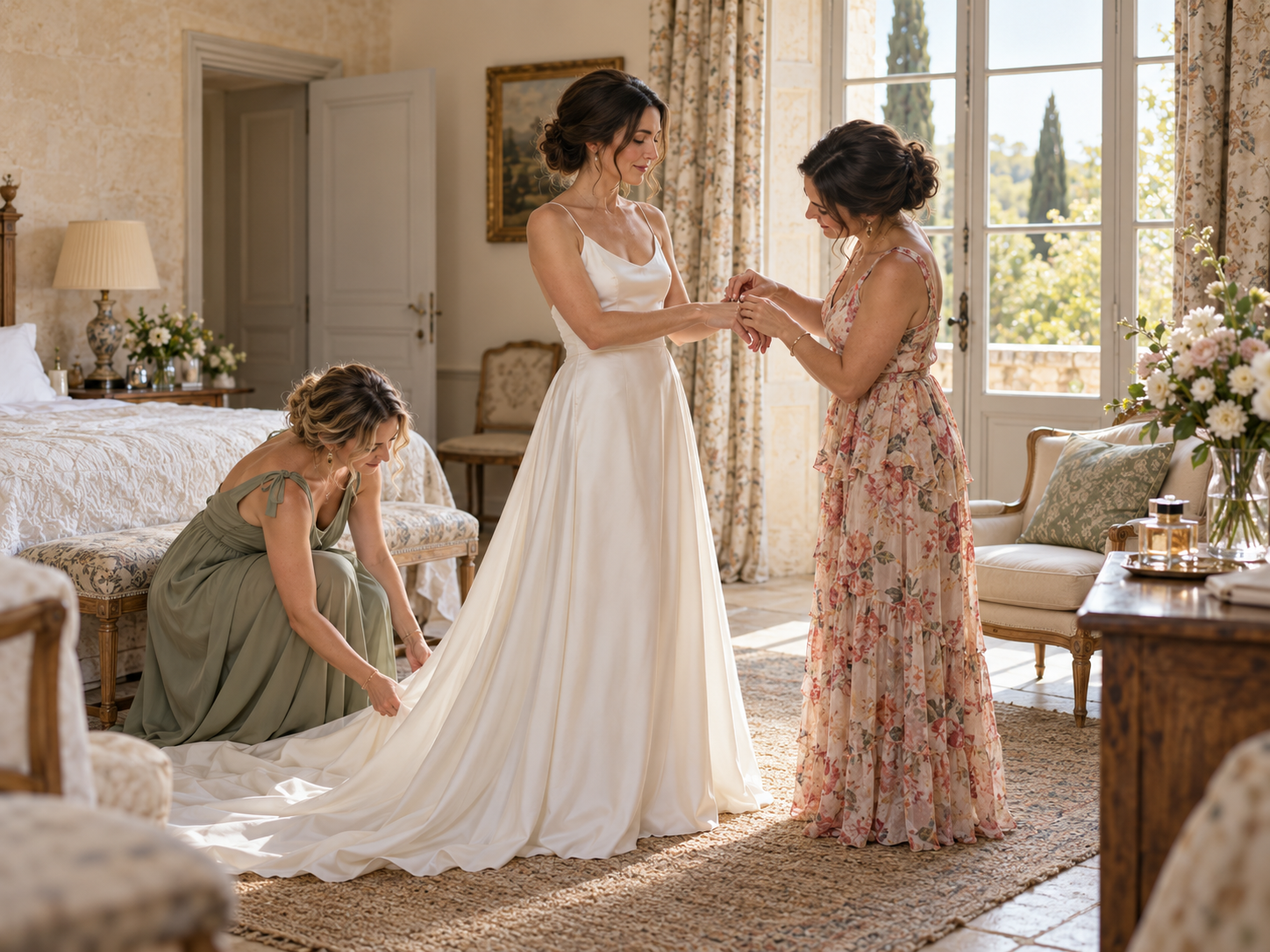


Your ceremony time also affects the calculation. A 4 p.m. ceremony with dancing beginning at 10:30 p.m. creates a very different photography timeline from an early ceremony followed by an afternoon reception.
If you want the beginning of the day documented, start by deciding what kind of wedding-morning story you actually want photographed. You do not necessarily need hours of makeup photographs simply because getting-ready coverage is included in other people’s galleries.
And if your photographer will be there during breakfast, hair and makeup, dressing and time with friends, what you wear for your wedding morning photos may appear in far more of the final gallery than you expect.
From there, work out how much wedding photography coverage you actually need before comparing eight-, ten- or twelve-hour packages.
Ask about overtime before signing the contract too. Find out whether additional coverage can be added on the wedding day, what it costs and how the decision is authorized.
If dinner runs late, you should know what extending coverage means before someone has to make that decision at 11 p.m.
Meet the Photographer Before You Book — Even If It’s on Zoom
For a destination wedding, an in-person meeting before booking may be completely impractical. You do not need to fly to France simply to meet a photographer.
A video conversation on Zoom, Google Meet or another platform can tell you much of what you need to know.
Pay attention not only to the answers but to the conversation itself.
Does the photographer listen before recommending what you need?
If you say family photographs are extremely important, do they take that seriously?
If you hate posing, can they explain how they work with someone who feels uncomfortable in front of a camera?
If you have not decided how much coverage you need, do they help you think through the timeline rather than immediately pushing a package?
You do not need to feel that you have found a new best friend. You do need to feel comfortable having this person close to you during some of the most private and emotional parts of the day.
For many destination couples, the first in-person meeting may happen during a planning trip, at an optional pre-wedding session, shortly before the wedding, or even on the wedding day itself. Good communication beforehand matters more than forcing an in-person meeting simply because it sounds traditional.
If most of your vendors will be chosen remotely, planning a wedding in France from the United States involves many of the same questions: what can be decided online, what genuinely benefits from a planning trip, and what needs to be verified locally.
If You’re Also Hiring a Videographer
Ask how the photographer normally works alongside video teams.
The photographer and videographer may both need access to the same moments: getting ready, a first look, the ceremony entrance, couple portraits, speeches and the first dance.
They do not need to have worked together before. What matters is whether both are comfortable coordinating positions, timing and portrait time without unnecessarily competing for the same space or directing the couple in conflicting ways.
Read Reviews for the Things a Portfolio Cannot Show You
Photographs can tell you a great deal about a photographer’s visual ability, but very little about what it is actually like to work with them.
When reading reviews, look beyond “we love our photos.”
Pay attention to repeated comments about communication, reliability and organization.
Did the photographer help when the timeline changed?
How did they interact with family and guests?
Did couples feel comfortable around them?
Did the final gallery arrive within the timeframe they had been given?
One enthusiastic review tells you relatively little. Patterns repeated across multiple independent reviews are more useful.
The portfolio tells you what the photographer can create. Reviews can help you understand the experience surrounding those photographs.
Ask How They Handle a Venue They Haven’t Photographed Before
Having photographed your exact venue can be useful, but it should not automatically become a requirement.
A photographer who has worked there before may already understand where the light falls, how long it takes to move between spaces and where portraits can work. But an experienced photographer should also know how to assess an unfamiliar location.
Ask how they prepare.
Do they arrive early? Review plans and timelines? Scout locations where appropriate? Coordinate with the planner or venue? Think through where portraits will happen if weather changes?
This matters in France because the visual conditions within one venue can vary enormously. A château may offer bright gardens outside and much darker historic rooms inside.
A Provençal property may have intense afternoon sun followed by a softly lit courtyard dinner. A Paris celebration may involve several locations and very different lighting conditions within a few hours.
Experience at one specific property is useful. Adaptability is useful everywhere.
France-Based Photographer or Someone Traveling With You?
Both can work. Compare the practical consequences rather than assuming one model is inherently better.
A photographer based in France may already be familiar with regional travel, local venues and French vendors. A photographer from your home country may already know you, speak your preferred language and have a visual style you particularly want.
If the photographer will travel for the wedding, establish how travel works financially and operationally.
Does the quoted price include transportation and accommodation?
When will the photographer arrive in France? Who books travel?
Are rental cars, trains, parking or local transfers included?
What happens if travel is disrupted?
For a rural wedding, “travel included” is not necessarily enough information.
A photographer arriving at Paris Charles de Gaulle still has to reach a château in Burgundy, the Loire Valley, Dordogne or Provence.
The goal is not to eliminate travel. It is to make sure the travel plan is robust enough that the person responsible for documenting the wedding is where they need to be before the wedding begins.
Language Can Matter Beyond Your Conversations With the Photographer
If you and the photographer can communicate comfortably, the most important language requirement is already solved.
But consider who else the photographer may need to communicate with.
Large family photographs can involve relatives speaking different languages.
A photographer may need to coordinate briefly with a French planner, venue manager, videographer or other vendors. For a highly international guest list, communication can become part of keeping photography efficient rather than simply part of building rapport.
Do not assume every photographer working in France speaks fluent English, and do not assume a photographer traveling from abroad needs fluent French. Ask how they normally manage communication at international weddings and decide whether that works for your particular group.
Understand Exactly Who Will Photograph Your Wedding
If you are hiring an individual photographer, the answer may be obvious. If you are booking through a studio or photography team, it may not be.
Make sure the portfolio you are evaluating corresponds to the person who will actually photograph your wedding.
Ask who is named in the contract, whether another photographer can be substituted, and what happens if the contracted photographer becomes ill or otherwise cannot attend.
A studio may have a formal replacement system.
An independent photographer may have a professional network they can call on. Neither arrangement guarantees that a replacement will ever be necessary, but you should understand the plan before you pay a deposit.
Ask About Backup Without Becoming a Camera Expert
You do not need to know camera models, memory-card specifications or hard-drive terminology to ask a sensible question about backup.
Try:
“Can you walk us through what happens if a camera, memory card or storage drive fails?”
A professional should be able to explain the safeguards in ordinary language.
Then ask the separate human-backup question:
“What happens if you personally cannot photograph the wedding?”
Equipment failure, file protection and photographer illness are different risks and need different plans.
The purpose is not to interrogate a photographer about technology. It is to establish that an event that cannot be repeated is being treated as such.
Compare What You Will Actually Receive
Once you have decided that you like the work and trust the photographer, packages become easier to compare.
Look beyond the headline number. Establish what the quote actually includes: coverage hours, number of photographers, travel, previews, final gallery, delivery timeline, downloadable files, albums or prints, and any other deliverables that matter to you.
Ask about additional hours and travel separately if they are not included.
This is especially important when comparing a local photographer with someone traveling internationally. A lower photography fee plus flights, accommodation and local transportation may produce a different final cost from an apparently higher all-inclusive quote.
Compare the wedding coverage you actually need, not package names.
Think About the Wedding Album Before the Wedding Is Over
You do not have to order an album when you book your photographer. You may not even know yet whether you want one.
But if a printed album is likely to matter to you, ask how it works before signing.
Is an album included or purchased separately? Can you order one after the wedding? Who designs it? How do revisions work? Can parents order smaller versions? If you prefer to create your own later, what files and usage rights will you receive?
Albums can differ in paper, construction, binding, cover materials, size and design process. Those differences are worth understanding before comparing a photographer-provided album with an independent album company.
Understand Image Use and Privacy Before Signing
Do not wait until photographs appear online to discover what the contract permits.
Read the sections covering your personal use of the photographs and the photographer’s ability to use images in their portfolio, website, social media, publications or vendor marketing.
If privacy matters to you, discuss it before signing. Some couples are perfectly happy for their wedding to become part of a photographer’s portfolio. Others do not want their ceremony, children, guests or private property published publicly.
Neither preference needs to be justified. It simply needs to be understood by both sides and reflected appropriately in the agreement.
Compare Photographers According to Your Priorities
By this stage, comparing Photographer A and Photographer B should be much easier because you are no longer trying to decide who is “better.”
You are comparing how each one fits your wedding.
A simple comparison might look like this:
What matters to us | Photographer A | Photographer B |
Couple photography | Love it | Like it |
Family & guests | Straightforward, enough for us | A major strength |
Strong daylight | Love it | Like it |
Evening & artificial light | Like it | Love it |
Venue & landscape | Strong | Strong |
Details | Limited | Extensive |
Direction | Minimal | More directed |
Full-gallery consistency | Very consistent | Day/night intentionally different |
Coverage | Fits our timeline | Extra hour needed |
Travel | Included | Separate |
Album | Optional | Included |
Communication | Very comfortable | Very comfortable |
Do not turn the table into a mathematical score unless numbers genuinely help you organize information. A photographer who appears stronger in more categories can still be a poorer fit if the other photographer is strongest in the three categories you care about most.
This is also why price works better near the end of the comparison than at the beginning. Once you understand what each photographer is actually giving you, you can compare the real difference rather than treating two packages with the same number of hours as equivalent services.
Choose the Photographer Whose Strengths Match What You Want to Remember
Years from now, you probably will not remember which photographer had the most polished Instagram grid.
You will have the photographs they made of the two of you, your parents, your friends, the rooms and landscape around you, and moments that happened elsewhere while you were occupied with something completely different.
That is why choosing a wedding photographer is not simply about finding work that looks beautiful.
Decide first what you most want the photographs to preserve. Then look for evidence that the photographer can consistently do those things under the conditions your wedding will actually create — in your type of venue, in your light, with your people and across the parts of the day that matter to you.
The most useful question is not “Who is the best photographer?”
It is:
“Whose strengths match what we most want to remember?”


Documentary Style vs Editorial style
Frequently Asked Questions
How far in advance should we book a wedding photographer in France?
There is no fixed deadline. If a particular photographer matters to you, starting around 12–18 months ahead gives you more opportunity to secure your preferred choice, especially for popular dates.
If your wedding is much closer, still ask. Availability varies by photographer, date and season.
Should our photographer have photographed our exact venue before?
No. Previous experience at the venue can be useful, but adaptability is more important than being able to name your château.
Ask how the photographer prepares for an unfamiliar venue and, where possible, look at a full gallery from a wedding with similar light, architecture and indoor/outdoor conditions.
Is one full wedding gallery enough?
One is much more informative than a highlights portfolio, but two or three can help you see whether the qualities you like remain consistent across different couples and conditions.
When possible, prioritize galleries that resemble your wedding in season, venue type, indoor/outdoor balance and reception lighting.
Do we need two photographers?
Not necessarily. A second photographer becomes more useful when important things you want documented will happen simultaneously or in separate locations.
Base the decision on your timeline and photographic priorities rather than assuming a particular guest count automatically requires two photographers.
Can we hire one photographer for the day and another for the reception?
Potentially, yes, provided both photographers agree and their contracts allow the arrangement.
The trade-off is that the two parts of your wedding may have noticeably different approaches to light, color, composition and editing. For some couples that distinction is intentional; others will prefer one cohesive visual interpretation of the entire day.
Can we meet a photographer on Zoom before booking?
Yes. A video call is a practical way for couples planning from abroad to assess communication and working style without making a trip to France solely for a meeting.
Pay attention to how the photographer responds to your priorities, not simply whether you like them personally.
Should we choose a photographer based on price?
Price should be part of the decision, but compare it after you understand what each photographer provides.
Coverage, travel, accommodation, second-photographer coverage, overtime, albums and other inclusions can make two apparently similar quotes quite different.
Related Planning Guides
FREE WEDDING PLANNING RESOURCES
Great Wedding Photos Start with the Right Questions
Finding a wedding photographer whose work you love is an important first step. Understanding how they work, what their packages include, and what to expect on your wedding day matters just as much.
Our free Wedding Vendor Questions: A Starter Guide includes 85 practical questions to help you have more informed conversations with photographers and other wedding professionals before making a commitment.
It's part of the ARONDE Free Wedding Planning Guides collection — five complimentary resources covering venues, budgets, vendors, planning essentials, and the guest experience.


