
Wedding Day Logistics in France: How to Build a Timeline That Actually Works

From vendor arrivals and setup to guest transportation, the ceremony, dinner, and the final departure, here's how to turn separate wedding arrangements into one coordinated plan.
Your florist is scheduled to arrive at the château at 9:00 AM. The furniture company is delivering ceremony chairs at 10:00 AM. Your photographer arrives at 11:00 AM, expecting the flowers and accessories to be ready for photographs.
On paper, everyone's on time.
But what if the florist can't begin until the chairs are positioned?
What if the delivery company only unloads at the entrance, while the ceremony garden is on the other side of the estate?
Or the person assigned to receive your bouquet is having her makeup done when the florist arrives?
These aren't necessarily scheduling mistakes. They're coordination gaps — details that a list of arrival times doesn't reveal.
Planning wedding day logistics in France means coordinating several locations, suppliers working under different contracts, guests staying in different towns, and often a historic property with specific operating conditions.
A wedding day timeline should connect those arrangements, not simply place them in chronological order.
Start With the Venue's Operating Conditions
Before choosing a ceremony time or building the morning schedule, establish the conditions that determine what is possible at your venue.
A French château may offer privatisation, meaning exclusive use of the property for an agreed period. That doesn't necessarily give every supplier unrestricted access throughout your stay.
The agreement may specify when deliveries can begin, when reception spaces become available, whether suppliers can install equipment the previous day, and when everything must be removed.
These details affect the schedule before the wedding day even begins.
For example, imagine an outdoor ceremony scheduled for 4:00 PM. Guests start arriving at 3:30 PM, so the ceremony garden must be completely prepared before then.
Your florist needs four hours for installation, but the venue doesn't release the garden until noon.
The available window is shorter than the planned installation time. You'll need to negotiate earlier access, adjust the decorations, arrange additional installation staff, or reconsider the schedule.
Each option may affect the budget.
Ask suppliers to clarify additional working hours, staffing requirements, and any changes to their devis — the French written quotation for their services.
Check the restrictions that affect the evening
The venue's rules also shape the end of the celebration.
Outdoor music may have a different finishing time from indoor dancing. Suppliers may need to stop working or remove equipment by a specified deadline.
Guest departures and final property clearance may be subject to separate conditions.
Don't assume that a late reception automatically allows late supplier access or next-day collection.
Our guide Wedding Venue Curfews in France: What to Ask About Music & Dancing explains which restrictions to confirm before finalizing your evening schedule.
Wedding Day Logistics in France: Build Your Timeline Backward
A guest-facing wedding schedule might look like this:
Time | Event |
4:00 PM | Ceremony |
4:45 PM | Cocktail hour |
7:00 PM | Dinner |
10:30 PM | Dancing |
1:00 AM | Guest departure |
Illustrative schedule only.
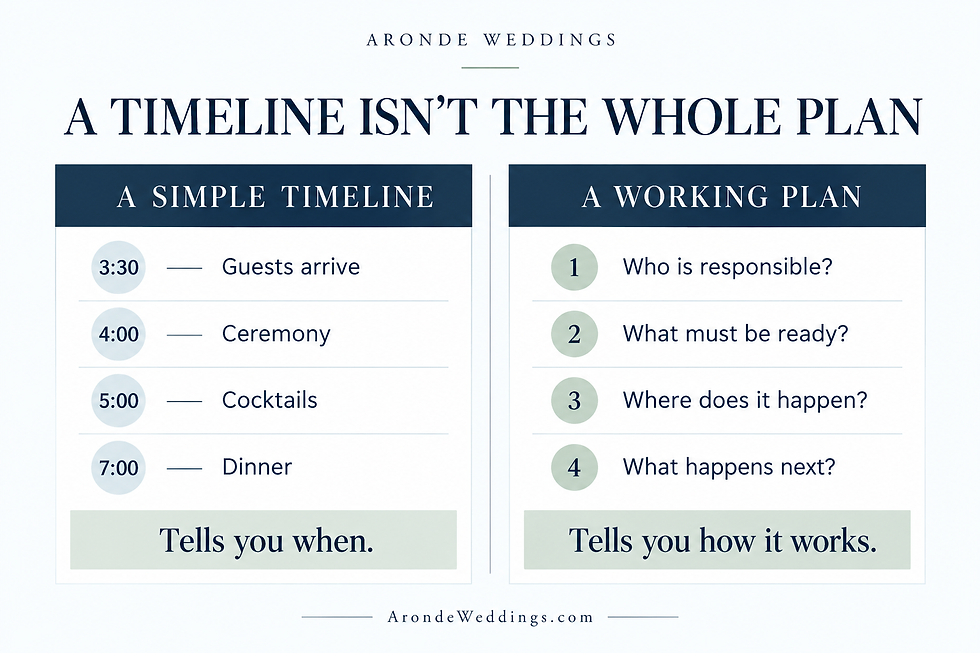
This tells guests roughly what to expect. It doesn't explain how the day will work.
Each event requires certain conditions to be met before it can begin.
The ceremony needs completed decorations, tested audio, seated guests, and participants ready for their entrances.
Dinner requires the dining space to be prepared, catering staff ready for service, and guests directed toward their tables.
Instead of scheduling only the visible moments, work backward to determine when everything supporting those moments must happen.
For a 4:00 PM ceremony, the sequence might be:
4:00 PM — Ceremony begins
3:45 PM — Guests seated
3:30 PM — Guest arrivals underway
Before 3:30 PM — Ceremony setup and final checks completed
Earlier — Suppliers finish installation and technical preparation
The exact times depend on the venue, number of guests, and suppliers involved. The principle is to establish the required preparation before fixing the final schedule.
Allow time to move between spaces
This is particularly relevant at French country estates.
The getting-ready rooms might be in the main château, the ceremony in a garden, cocktails on a terrace, and dinner in a converted barn.
These locations can be close on a property map but still require several minutes of walking.
Guests may need to navigate gravel, steps, garden paths, or corridors. Some will move more slowly than others.
If the ceremony finishes at 4:30 PM, don't automatically schedule another activity for everyone at 4:35 PM in a different part of the estate.
Walk the actual routes and account for the movement between events.
For a more detailed look at ceremony entrances, guest seating, sound, and transitions, read How to Plan a Wedding Ceremony in France: From Vows to the Final Exit.
Coordinate Vendor Arrivals, Deliveries, and Setup

A wedding morning may involve several independent teams working in the same spaces.
The furniture rental company delivers chairs and tables. The florist installs arrangements. The traiteur, or French caterer, prepares the kitchen and dining service. Technicians install lighting and sound equipment.
Their schedules may be individually correct while creating conflicts when combined.
Delivered Doesn't Always Mean Ready
Imagine the rental company delivering 90 ceremony chairs at 9:00 AM, exactly as agreed.
The florist arrives at 10:00 AM, expecting to begin decorating the aisle. The chairs, however, are still stacked near the service entrance.
The delivery team has already left because its contract covered transportation and unloading, not carrying the chairs into the garden or arranging them.
The venue staff are preparing the reception space and haven't been assigned to move furniture.
Now the florist is waiting, even though both suppliers arrived on time.
Before confirming delivery schedules, establish who unloads, carries, positions, and later collects each rental item. The florist's start time depends on when the chairs are in place, not when the delivery truck enters the property.
How to Choose Wedding Vendors in France explains how to clarify responsibilities and compare supplier services before signing contracts.
Give suppliers an exact arrival location
A historic property may have several entrances, service gates, parking areas, or buildings.
Providing only the château's street address may not be enough.
Your supplier instructions should identify the correct entrance, unloading location, contact person, and access arrangements.
If the gate is locked when the supplier arrives, someone must be available to open it.
These instructions should be shared before the event, especially when suppliers are arriving independently.
Check which tasks depend on other teams
Some work can happen simultaneously. Other work has a necessary sequence.
The florist may need furniture in position before decorating tables.
Lighting technicians may need access to the ceiling before the dining room is fully dressed. The photographer may want images of completed decorations before guests enter.
Ask each supplier what must already be available or completed before their work can begin.
This helps identify where one delayed delivery could affect several other teams.
Plan Getting Ready as More Than Hair and Makeup

The morning schedule often begins with beauty appointments and ends with the bride putting on her dress.
In reality, getting ready involves several connected activities: breakfast, hair, makeup, photography, personal flowers, accessories, dressing, and the journey to the ceremony.
Each person may have different requirements.
Someone participating in the morning photographs may need to be fully dressed earlier than someone who isn't involved.
The bride needs time after hair and makeup for getting dressed, putting on jewelry, final adjustments, photographs, and moving to the ceremony location.
The schedule should reflect what is actually planned rather than assuming everyone can be ready the moment their beauty appointment ends.
Make sure responsible people are available
When 11:00 AM Doesn't Mean Photography Starts at 11:00 AM
Imagine your photographer arrives at 11:00 AM, exactly as scheduled. Everyone who needs to participate in the getting-ready photographs has finished hair and makeup.
Except the room is covered with open suitcases, breakfast dishes, clothing, makeup bags, and shopping bags.
Someone begins clearing the furniture and finding places to hide everything. Ten minutes pass.
Now the photographer is ready to begin the detail photographs, but nobody can find the invitation suite, jewelry, or other items intended for the flat-lay arrangement. Another ten minutes disappear.
Photography begins at 11:20 AM.
Nobody arrived late, yet 20 minutes of the booked photography time have already been used.
If the couple needs to leave for the ceremony at a fixed time, those missing minutes may reduce the time available for portraits or other planned photographs.
The solution isn't necessarily to book more photography hours. It's to prepare the room and gather the required items before the photographer arrives.
Assign someone to make sure the space is ready, not merely that the people in it are ready.
Remember the small transitions
Getting dressed, putting on a veil, collecting personal belongings, and moving between rooms all take time.
If the getting-ready suite is upstairs and the ceremony takes place in a garden on the other side of the château, the couple needs a realistic route and enough time to use it.
Historic French properties may have narrow staircases, uneven paving, or rooms spread across separate buildings.
A schedule that leaves no time between the final preparation and the ceremony can become difficult to follow even when every beauty appointment finishes as planned.
Make Guest Transportation Part of the Wedding Timeline

Guest transportation is especially important when accommodation is spread across several towns or villages.
Some guests may stay at the château, while others use nearby hotels, guesthouses, or rental properties.
The accommodation arrangements determine where pickup points are needed and how many passengers must travel from each location.
If you're still deciding where guests should stay, Wedding Venues With Accommodation in France: What You Need to Know explains how on-site accommodation affects the wider wedding arrangements.
Why a 12:00 PM Shuttle Might Leave at 12:15 PM
The shuttle is scheduled to depart the hotel at noon.
The driver arrives on time, and most guests are waiting.
Then Aunt Nancy realizes she's left her glasses in her room. She goes back upstairs.
Just as she returns, Uncle James remembers that he hasn't packed the medication he'll need later that afternoon.
Neither delay is particularly dramatic. Both are understandable.
But by the time everyone is aboard, it's 12:15 PM.
If the shuttle is making another hotel pickup before reaching the venue, those 15 minutes may affect the second group as well. Guests could arrive later than expected, leaving less time to find the ceremony location and take their seats.
This is why a shuttle schedule should include a boarding window, not just a departure time.
Tell guests when they need to be ready, assign someone to help manage departures, and confirm with the transportation company how delays will be handled.
Plan around arrival at the ceremony, not departure from the hotel
A shuttle schedule needs to include more than driving time.
Guests must reach the pickup point, board the vehicle, travel to the venue, disembark, and walk to the ceremony area.
If the ceremony begins at 4:00 PM and guests should be seated by 3:45 PM, the transportation schedule needs to work backward from 3:45 PM.
At some rural venues, coaches cannot enter the main driveway or turn around close to the building.
The designated drop-off point may be farther away than expected, adding another stage to the guest journey.
Wedding Transportation in France: Complete Guide covers routes, pickup arrangements, vehicle access, and return journeys in greater detail.
Assign someone to manage departures
The driver's responsibility may be to arrive at the agreed location and operate the vehicle.
That doesn't necessarily include checking which wedding guests have boarded, contacting late passengers, or deciding whether to delay departure.
If guests are leaving on several shuttles, someone needs to manage those arrangements.
Confirm who checks passenger groups, who communicates with drivers, and what happens when a guest misses their scheduled departure.
In rural France, don't assume guests can easily order Uber or Taxi.
Connect the Ceremony, Cocktails, Photography, and Dinner
These parts of the wedding appear separately in most timelines, but they influence one another.
A ceremony that finishes late may reduce the time available for portraits. Family photographs may delay the couple's arrival at cocktails.
A longer cocktail reception can affect when dinner begins.
This doesn't mean every delay creates a problem.
It means the schedule should identify which activities have flexibility and which ones are constrained by other arrangements.
Plan the ceremony-to-cocktail transition
When the ceremony finishes, guests may want to congratulate the couple before moving toward the cocktail area.
If cocktails take place elsewhere on the estate, someone should direct guests to the correct location.
If the ceremony chairs or sound equipment are needed for the next event, confirm who moves them and when.
Moving furniture while guests are still seated or greeting the couple can create unnecessary disruption.
Where possible, allow guests to move naturally to the next location before the team begins clearing the ceremony area.
When a Five-Minute Speech Becomes Fifteen
Dinner is running on schedule. The catering team is preparing the next course, and the father of the bride has been given five minutes for his speech.
He's enjoying the moment, the guests are laughing, and he has several more stories to share.
Fifteen minutes later, he's finally finished.
For the guests, the extra stories may be delightful. For the kitchen, they can create a timing problem. Food may already be prepared, service staff may be waiting, and the next course or scheduled entertainment may need to move.
The answer isn't to rush every speech.
Agree with the caterer when speeches can take place, communicate realistic expectations to the speakers, and give someone responsibility for coordinating transitions with the kitchen.
For further guidance, see How to Choose a Wedding Caterer in France: Traiteur, Menus, Staffing & Hidden Extras.
The Cake Moment Nobody Photographed
Imagine the photographer's coverage ends at 10:00 PM. That's exactly what the couple booked and what the photographer agreed to.
At 10:30 PM, the catering team brings out the wedding cake.
The couple cuts the cake, the guests gather around, and the moment unfolds as planned.
But the photographer has already left.
Nothing went wrong with either supplier's schedule. Their separate arrangements were never checked against each other.
Before finalizing the evening program, compare the timing of your must-have photographs with the photographer's contracted coverage.
If a planned moment falls outside that window, decide whether to move it, arrange additional coverage, or simply enjoy it without professional photographs.
Assign Responsibilities That People Can Actually Carry Out

A wedding timeline may list every event correctly and still leave important tasks without an owner.
The venue provides a manager. The caterer has a service manager. The DJ controls the music. The photographer manages the photography schedule.
But who makes sure the wedding party is ready before the ceremony? Who directs guests toward dinner? Who confirms the rings have reached the ceremony area
These responsibilities should be established before the wedding.
Don't rely on job titles alone
A venue manager may be responsible for the property rather than the entire wedding.
A catering manager may oversee food service but not guest transportation or the ceremony processional.
A wedding coordinator may manage the overall sequence, but their scope depends on the services agreed upon.
Clarify who handles each activity, especially where several suppliers are involved.
The Bouquet That Never Reached the Bride
The florist delivers the bridal bouquet to the château in the morning.
A bridesmaid receives it and places it somewhere cool and safe before returning to her preparations.
Later, the bride is ready for her first look, but nobody knows exactly where the flowers were left.
The bridesmaid is in another room, the florist has moved on to the ceremony setup, and the photographer is waiting.
The bouquet isn't missing. Its location simply wasn't communicated to the next person who needed it.
For important items, identify the person who receives them, where they're stored, and who takes responsibility for the next handoff.
A delivery is only complete from the wedding's point of view when the item reaches the person who needs it.
Check for conflicting responsibilities
Someone cannot supervise shuttle arrivals at the venue entrance while simultaneously participating in family photographs elsewhere on the property.
A person getting ready for the ceremony isn't necessarily available to receive deliveries.
When assigning responsibilities, check whether the same person has commitments in different locations at overlapping times.
This is especially important for smaller weddings where family members are helping with several tasks.
Decide How Changes Will Be Managed
Even a carefully prepared wedding may need adjustments.
A supplier arrives late. A shuttle is delayed. Rain requires the ceremony to move indoors. A speech runs longer than expected.
The goal isn't to predict every possible problem. It's to establish who can make decisions and how those decisions will be communicated.
A rain plan needs people and timing, not just a room
An indoor alternative is useful only if it can accommodate the guests and be prepared within the available time.
Suppose the ceremony is planned in the garden, but rain requires moving it into a reception room.
Someone must confirm that the room is available. The seating needs to be arranged. The florist and audio provider may need to relocate equipment.
Guests must receive updated directions, and the officiant and photographers need to know where the ceremony will take place.
Agree on who makes the final decision, when it must be made, and which suppliers need to act.
How to Evaluate a French Wedding Venue's Rain Plan examines these practical requirements in detail.
Identify what can move and what cannot
Some parts of your schedule are relatively fixed.
The photographer's contracted coverage may end at a particular time. The caterer may have service requirements.
The venue may impose restrictions on amplified music and final guest departures.
Other activities may be easier to adjust.
Rather than placing the same arbitrary buffer between every event, identify where delays are most likely to affect another activity and discuss realistic alternatives with the people involved.
A useful timeline shows where flexibility exists without assuming the entire evening can simply move later.
Plan the End of the Night and the Following Morning
The operational schedule continues after the last dance.
Guests still need transportation. Suppliers may need to remove equipment. Personal belongings must be collected, and the venue may have specific requirements for clearing rooms or outdoor areas.
When the Last Shuttle Is Ready but the Guests Aren't
The final shuttle is scheduled to leave at 1:00 AM.
Most guests are waiting near the pickup area, but a few are still saying goodbye to the couple. Someone has returned to the dining room for a handbag, and another guest is looking for their jacket.
The driver is ready to depart.
Whether the vehicle can wait depends on the transportation agreement and any other commitments the driver has that night.
Someone needs to know which guests are expected on that shuttle, where they are, and what should happen if they haven't arrived by departure time.
Confirm those arrangements with the transport provider rather than assuming the driver can extend the service.
A scheduled departure is useful only if there is a practical way to get passengers onto the vehicle.
Confirm what happens after guests leave
Some suppliers may be able to return the following morning. Others may require collection immediately after the event.
The venue may have a deadline for démontage, meaning dismantling and removing installations.
Make sure collection times agree with the property's access rules.
If the final guest departure is scheduled for 1:00 AM, don't assume rental furniture can also be removed at that time without additional staff or a separate collection window.
Confirm who is responsible for personal decorations, gifts, clothing, accessories, and any items that shouldn't be left at the venue.
Include the following day
For a multi-day celebration, the next morning may involve breakfast, brunch, guest checkout, luggage, rental collection, and a final inspection of the property.
If you're flying back to the United States shortly after the wedding, these arrangements deserve particular attention.
Someone should know which items belong to you, which belong to suppliers, and what must be returned before leaving.
How to Plan a Wedding Weekend in France explains how to coordinate the wedding day with the events before and afterward.
Turn Separate Schedules Into One Working Wedding Day Plan
By the final stages of preparation, wedding information often lives in several places.
The venue has its operating schedule. The caterer has a service plan. The photographer has a shot list and coverage hours. The transportation company has an itinerary.
You may also have spreadsheets, notes, emails, and conversations with family members.
Each source contains useful information, but none necessarily explains how everything works together.
Your complete wedding day plan should connect five elements:
Element | What it establishes |
Time | When something needs to happen |
Location | Exactly where it happens |
Activity | What needs to be done |
Responsibility | Who is accountable for completing it |
Dependency | What must be ready or completed first |
For tasks involving several people, include who hands something over and who receives it.
For example, it's not enough to write "Bouquet delivery — 11:00 AM."
A workable instruction identifies where the bouquet is delivered, who receives it, when the photographer needs it, and who brings it to the bride afterward.
One master plan, different instructions for different people
Not everyone needs the complete operational schedule.
The florist needs installation requirements, access information, deadlines, and relevant contacts.
The driver needs pickup times, routes, passenger arrangements, and the name of the person managing departures.
A family member may need to know when to be ready for photographs, what they're responsible for bringing, and where they should go afterward.
Prepare instructions that are specific to each person's role while keeping them consistent with the overall schedule.
If the ceremony time changes, the relevant supplier and guest instructions must change as well.
A Timeline Can Be Correct and Still Not Work
Look back at these situations.
The photographer arrived on time. The chairs were delivered as agreed. The shuttle was waiting outside the hotel. The caterer prepared dinner according to schedule.
Yet each situation created a delay or required someone to step in.
The missing information wasn't necessarily another time on the calendar.
It was the condition that needed to be met, the person responsible for making it happen, or the connection between one activity and the next.
When building your wedding day plan, review those connections alongside the timeline itself.
From a Timeline to a Complete Wedding Day Plan
You can organize your wedding logistics yourself using a spreadsheet, clear supplier confirmations, and carefully prepared instructions.
For a small wedding with few suppliers and locations, that may be entirely sufficient.
As the celebration involves more people, spaces, and activities, however, the work extends beyond writing times into a table.
You need to coordinate separate planning areas, check responsibilities, track details that still require confirmation, and communicate the correct information to everyone involved.
That's the difference between having a wedding timeline and having a plan that other people can actually follow.

ARONDE Wedding Day Master Plan
One wedding plan. Clear responsibilities. A better way to bring everything together.
The ARONDE Wedding Day Master Plan is being developed as a practical planning toolkit for couples who want to organize the operational side of their wedding themselves.
The goal is to bring together the schedule, people, responsibilities, and instructions that are often scattered across separate spreadsheets, emails, and messages.
The planning process follows five connected stages:
BUILD — Organize the people, locations, activities, and requirements of your wedding day.
CHECK — Review dependencies, missing details, and arrangements that may conflict.
ASSIGN — Establish who is responsible for each task and handoff.
COMMUNICATE — Prepare clear instructions for the people involved.
RUN — Use the completed plan to guide preparations and wedding-day coordination.
The toolkit is designed to support your own planning process, whether you're organizing the wedding independently or preparing information for a professional coordinator.
Explore the ARONDE Wedding Day Master Plan →
Coming soon.
Before You Finalize the Wedding Day Schedule
Review the plan with your venue and principal suppliers, particularly where several teams share spaces, equipment, or responsibilities.
Confirm the information that affects other people's work: access times, setup deadlines, guest arrival arrangements, ceremony preparation, dinner service, and the final collection of equipment.
Make sure important tasks have named owners, and that everyone affected by a schedule change receives updated instructions.
If you're hiring a wedding coordinator, confirm which responsibilities they will manage on the day. A planning toolkit can help organize the information, but it doesn't replace a professional physically present to coordinate people and respond to problems.
The most useful wedding day plan isn't necessarily the one with the most detailed timeline. It's the one that gives everyone enough accurate information to do their part without repeatedly turning to the couple for answers.
Where to Go From Here
Organize the earlier planning stages, from major bookings and contracts to the decisions that need to be settled before building the wedding day schedule.
Consider how transportation, accommodation, communication, and movement between events affect the experience of your guests.
Learn how to evaluate suppliers, clarify responsibilities, and understand what's included in their services before building your final plan.


