
Lace Wedding Dresses 2027: Trends, Details & Ideas
Updated: Oct 23

For 2027, lace is appearing in far more forms than the traditional all-over lace gown.
Alongside full lace gowns, the material is appearing as translucent layers over corsetry, delicate Chantilly, dimensional appliqué, sheer sleeves, graphic motifs, and carefully placed details on otherwise clean dresses.
The result is a much broader idea of what a lace wedding dress can be.
You can choose a gown where lace defines the entire silhouette or use it almost like an accent. It can create softness over a structured bodice, make transparency part of the design, bring texture to a minimal dress, or become the detail that transforms a simple silhouette.
So if you already know you like lace, the next question is more useful than simply asking whether lace is “in” for 2027:
What kind of lace do you actually want to wear?
If you are still exploring the season more broadly, start with Wedding Dress Trends 2027: 6 Bridal Fashion Directions to Know before narrowing down the details.
Lace Wedding Dresses 2027: All-Over Lace Is No Longer One Look

An all-over lace gown is the most recognizable version of a lace wedding dress: the textile continues across most or all of the silhouette rather than appearing only in selected areas.
But two all-over lace dresses can look completely different.
Fine, closely spaced lace over an ivory lining can create a relatively quiet surface. A larger floral or graphic motif becomes much more visible from a distance. Lace over a contrasting or skin-toned foundation emphasizes the pattern, while ivory over ivory lets it blend more closely into the dress.
Silhouette changes the effect again. The same lace can feel delicate over a narrow column, more architectural over a corseted gown, or much more dramatic when repeated across a full skirt and train.
This is why choosing lace from a small swatch is difficult.
Look at the textile close up, then step several feet away from the dress. Take a full-length photograph. Y
ou may discover that the tiny pattern you loved in your hand almost disappears across the complete gown — or that a motif that looked subtle on a sample becomes the dominant visual element once repeated from neckline to hem.
Neither is better. The question is whether you want people to notice the silhouette first, the lace first, or both at once.
2. Chantilly Lace Creates a Finer, More Delicate Surface
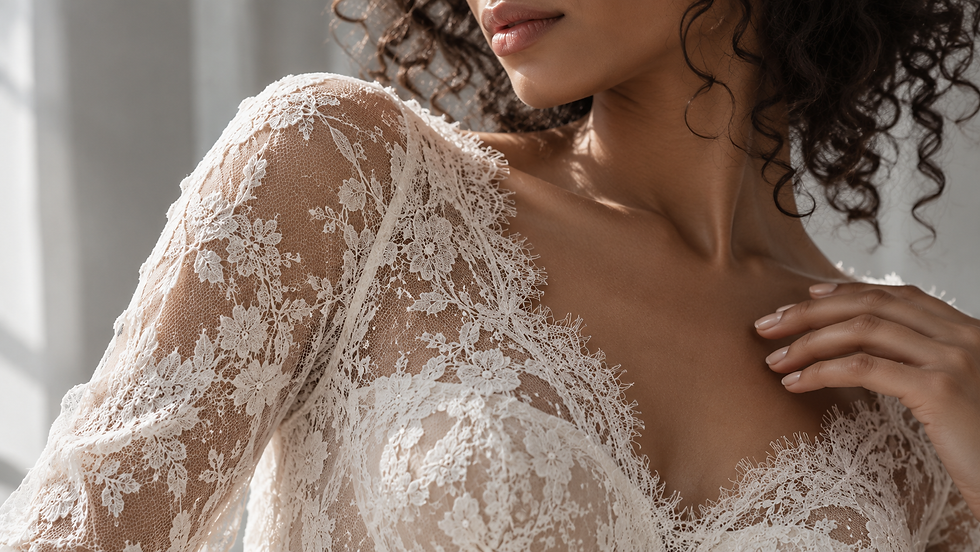
Chantilly lace is known for fine patterning and a visually lightweight quality. That makes it especially effective when you want texture without the heavier visual effect of a dense lace surface.
But Chantilly can produce very different results depending on what sits underneath it.
Placed over an ivory foundation, it can appear soft and subtle. Against skin or a contrasting lining, the pattern becomes much more visible. Layered with sheer fabric, it can seem almost suspended over the body.
That makes the foundation nearly as important as the lace itself.
And if you are considering Chantilly because you want a physically light dress, look beyond the surface. Fine lace can still sit over boning, cups, corsetry, lining, tulle, and multiple skirt layers.
A dress can look delicate without being lightweight.
The complete construction will tell you much more about how the gown feels than the lace alone.
3. Sheer Lace Makes the Construction Part of the Look

Sheer lace can range from a barely translucent sleeve or neckline to a bodice where transparency is one of the main design elements.
In some dresses, lace sits over visible corsetry so that boning, cups, and the internal architecture of the bodice deliberately become part of what you see.
If you like this look, pay attention to the transitions.
Where does the lining begin and end?
How visible are the cups or boning?
Do illusion panels blend naturally with your skin?
Does the effect change when light comes from behind you?
Then move in the dress.
Raise your arms. Turn sideways. Sit. Look at it near a window as well as under salon lighting. A sheer section that seems almost invisible while you are standing still can become more apparent when the garment moves or the light changes.
The goal is not necessarily to make the construction disappear. It is to decide how much of it you want to see.
4. Lace Appliqué Gives You Texture Without Covering the Whole Dress

If you like lace but do not want an uninterrupted patterned surface, appliqué gives you much more control over where the detail appears.
Individual lace motifs are attached to another fabric rather than forming the entire textile. They might concentrate around a bodice and gradually disappear into the skirt, frame a neckline, continue onto sheer sleeves, emphasize a back, or scatter across tulle with open space between them.
The result can feel completely different from an all-over lace gown.
Appliqué can also create physical dimension. Raised motifs catch light and form small shadows, giving the surface more depth than a flat lace pattern.
This works particularly well if you want a dress that changes depending on viewing distance: a clear silhouette from across the room, with much more detail appearing as someone comes closer.
5. Lace and Corsetry Create an Interesting Contrast
Lace and corsetry perform different jobs.
Corsetry creates structure and support. Lace adds pattern, transparency, softness, or texture.
Put the two together and the contrast can become one of the defining elements of the dress. Lace may soften a highly structured bodice, or it may be sheer enough that the internal construction remains deliberately visible.
If this is the look you like, examine both layers separately.
Ask yourself whether you love the lace itself, the visible structure underneath it, or the interaction between the two.
Then test the bodice as something you will actually wear. Sit for several minutes. Take a full breath. Turn your torso. Raise your arms.
A corseted lace gown may provide exactly the support and silhouette you want, but after several hours the structure underneath the lace may matter more to your comfort than the surface you first noticed in the mirror.
6. Long Lace Sleeves Can Behave Very Differently

A lace sleeve can look visually light because skin remains visible through the pattern.
That does not necessarily tell you how it will feel.
A fine sheer sleeve may offer substantial flexibility. Dense embroidery, lining, a narrow armhole, tight cuff, or more rigid lace can produce a completely different experience.
If you are trying on a long-sleeved lace dress, move your arms rather than judging it only in front of the mirror.
Reach forward as though hugging someone. Bend your elbows fully. Raise your hands above your head. If you plan to dance, try a few of the movements you are likely to make later.
7. Lace Can Be One Part of a Cleaner Dress
Loving lace does not mean you need a full lace gown.
A lace bodice can meet a simple skirt. Sheer lace sleeves can be added to an otherwise minimal silhouette. Appliqué can appear only around the neckline or back.
A translucent lace layer can sit over a clean base without covering the entire dress.
This approach works particularly well if your taste falls somewhere between minimal and decorative.
Instead of asking:
Do I want a lace wedding dress or a simple wedding dress?
Try asking:
How much lace do I actually want the dress to carry?
The answer might be the entire gown.
It might also be one sleeve, one panel, one layer, or one beautifully constructed section.
8. The Scale of the Lace Pattern Changes the Entire Dress

Lace is not one visual texture.
Small, densely repeated motifs can create an almost continuous surface from a distance. Large floral or graphic motifs become part of the overall composition of the dress.
Widely spaced appliqué leaves more of the foundation fabric or skin visible.
Dimensional motifs behave differently again because they create actual depth and shadow.
This means two dresses with nearly identical silhouettes can feel completely unrelated simply because the scale and density of their lace are different.
When comparing them, look at the lace from three distances.
Close up: Do you actually like the motif and workmanship?
Mirror distance: How does the pattern interact with the silhouette?
Full-length photograph: Can you still see the feature that made you choose the lace?
You may start with “I love lace” and discover that what you actually love is much more specific: fine continuous texture, oversized florals, scattered appliqué, or dimensional detail.
That is a much more useful thing to know when shopping.
9. The Lining Can Change Lace Almost as Much as the Lace Itself

The layer underneath lace is easy to overlook because your attention naturally goes to the surface.
But change the lining and you can change the entire visual character of the dress.
Ivory lace over ivory reduces contrast and allows the textile to blend more closely into the silhouette. Put lace over nude, blush, champagne, or another contrasting foundation and the pattern becomes much more prominent.
Neither approach is inherently more modern.
The better question is what you want to register first when someone looks at the dress.
Do you want the lace pattern to be immediately visible?
Or do you want the silhouette to read first, with the lace becoming more apparent at closer range?
If different lining options are available, photograph them. Natural window light, outdoor shade, and flash can all change the amount of contrast you perceive between lace, lining, and skin.
Sometimes changing what sits under the lace has more impact than changing the lace itself.
10. Lace Can Look Completely Different in Photographs

Lace gives a photographer several things to work with: pattern, transparency, texture, edges, and sometimes three-dimensional detail.
But no single photograph can show all of them equally well.
Fine lace may look intricate in a close portrait and become almost invisible in a wide environmental photograph. Larger motifs remain more apparent from farther away. Dimensional appliqué catches light and shadow. Sheer lace can become more pronounced when light passes through it.
Think about what made you choose your particular dress.
If it is the tiny workmanship, scalloped edge, intricate sleeve, or raised floral detail, include closer photographs. If you love the way the entire lace silhouette looks, full-length and movement photographs become more important.
This is particularly relevant at a destination wedding because the setting often encourages wider images: a Paris street, château garden, coastline, vineyard, or mountain landscape.
A wide portrait can show the relationship between you, the dress, and the place.
A close-up can show why you chose that particular lace.
You can have both.
11. Lace Does Not Have to Belong to the Main Wedding Dress

If you love lace but do not want it to dominate your main gown, it can appear elsewhere in the wedding wardrobe.
A lace top can work with tailored trousers or a separate skirt. A lace mini can become an after-party look. A removable lace layer can change a cleaner ceremony dress. A lace coat or overskirt can introduce texture and then disappear later.
That does not mean a destination wedding requires multiple bridal outfits.
Sometimes one lace element gives you the visual idea you wanted without requiring another complete dress.
If you are considering changing outfits primarily for comfort or movement later in the evening, Do You Need a Second Wedding Dress? can help you decide whether another look would genuinely improve the experience.
Before Choosing a Lace Dress for a Wedding in France

Once you have narrowed down the lace you like, the wedding itself becomes part of the decision.
Not because France requires a particular bridal style, but because the dress still has to function in the setting you have chosen.
For a warm-weather wedding, look at the complete construction rather than assuming an airy-looking lace dress will feel cool.
At a château or countryside property, examine the lower edge if lace continues into the hem or train. Gravel, lawns, historic stairs, and movement between buildings may mean the train needs to be lifted or bustled more frequently.
For a Paris wedding or micro-wedding, think about walking, getting into cars, moving between portrait locations, and sitting for lunch or dinner. A restrictive stride or difficult train can matter more when the wedding involves moving through the city.
At a coastal wedding, see how light lace layers, sleeves, veils, and trains behave in wind.
None of these conditions means you should avoid a particular dress. They simply tell you what to test.
Walk normally. Take a longer step. Sit. Raise your arms. Turn. Dance. If the dress has a train, ask to see how the bustle actually works.
If you are still choosing the setting itself, Wedding Venues in France: Complete Guide to Venue Types can help you compare the practical differences between French wedding environments.
Look at the Alterations Before You Buy
Precise lace placement can make some alterations more involved.
Motifs may cross seams, frame a neckline, form a scalloped hem, or be positioned carefully around sheer sections.
Altering the underlying garment can therefore require lace to be removed and repositioned so the finished design still looks intentional.
If you expect significant alterations, ask how the lace is attached and whether the areas likely to change contain important motifs or edges.
Think About How the Dress Will Travel
A soft lace gown and a heavily structured dress with dimensional appliqué, delicate openwork, beading, or a long train may need very different handling.
Before traveling, understand which areas of the garment need protection. Once you arrive, give the dress enough space to hang and inspect it before deciding what preparation it needs.
Do not automatically steam an unfamiliar lace gown. Follow the garment's care instructions, particularly when embellishments or complex construction are involved.
How to Choose Between Lace Wedding Dresses
If several lace dresses appeal to you, comparing them only by asking which one is prettier will not tell you very much.
Instead, compare the decisions inside the dresses.
Look at the lace itself. Do you prefer fine continuous texture, larger graphic motifs, dimensional appliqué, or lace used only as a detail?
Look at how much lace you want. All-over lace creates a very different effect from a clean dress with sheer sleeves or one appliquéd section.
Then look underneath it. Is the lace lined or sheer? Is there visible corsetry? How much structure is underneath the surface?
Move in it.
Walk, sit, raise your arms, take a long step, turn, and think about dancing.
Finally, put the dress into the wedding you are actually planning: the season, setting, photography, transportation, length of wear, and what you want to do while wearing it.
At that point, you are no longer comparing abstract lace wedding dresses.
You are comparing how different versions of lace would actually become part of your wedding.

Frequently Asked Questions
Is a Lace Wedding Dress Too Warm for a Summer Wedding?
Not necessarily. The lace itself does not tell you how warm the complete garment will feel. Look at the lining, internal bodice, sleeves, skirt layers, and overall construction.
Which Type of Lace Shows Best in Wedding Photographs?
It depends on the photograph. Fine lace often shows more clearly in close-ups, while larger motifs and dimensional appliqué can remain visible from farther away. If the textile is one of the reasons you chose the dress, plan both full-length and detail photographs.
Is All-Over Lace Harder to Alter?
Not automatically. The important factor is how the lace is positioned and attached. Scalloped hems, appliqué crossing seams, motifs around necklines, and carefully positioned lace on sheer sections can make alterations more involved.
Can a Lace Wedding Dress Work for a Paris Micro-Wedding?
Yes. Consider how the particular dress works with the way you plan to experience Paris: walking, transportation, stairs, restaurant seating, portrait locations, and the amount of train you want to manage.
Is Chantilly Lace Good for a Summer Wedding?
It can be. A fine Chantilly surface may look very light, but the layers and structure beneath it determine much of the dress's actual weight and warmth.
Do I Need a Full Lace Gown to Get the Lace Look?
No. Lace can be concentrated in sleeves, a bodice, back, neckline, appliqué, detachable layer, overskirt, or another part of the bridal wardrobe.
Lace Is the Material. The Dress Is the Decision.

The most interesting thing about lace wedding dresses in 2027 is the range of ways the material can be used.
It can cover an entire gown or barely appear. It can be fine and translucent, large and graphic, layered over visible structure, scattered as dimensional appliqué, or concentrated into one element of an otherwise clean dress.
Start by noticing which version actually attracts you.
Then look beneath the surface. Consider the foundation, construction, pattern scale, movement, comfort, photography, and how much lace you genuinely want to wear.
The real decision is much more specific:
Which kind of lace creates the dress you want — and works for the wedding you are actually planning?


