
Second Wedding Dress Trends 2027: Reception & After-Party Looks
Updated: Oct 23

The second wedding dress trends in 2027 is becoming much more than a short white dress reserved for the dance floor.

Across Spring 2027 bridal collections, lace, halter necklines, asymmetry and dramatic draping are appearing alongside fluid '90s-inspired silhouettes, softer colors and increasingly flexible ways to change a bridal look throughout the day.
At the same time, detachable layers and bridal separates are making the line between “one dress” and “two looks” much less defined.
That makes the second look an interesting fashion decision—but not an automatic one.
Some brides want more freedom to dance. Some want a clear transition from a formal ceremony to a late-night party. Others simply want the opportunity to wear something completely different.
The most useful question isn't how many bridal looks you should have. It's what you want the second one to do.
Here are the wedding dress trends shaping reception and after-party looks for 2027, followed by several emerging directions worth watching.
Lace Moves Beyond the Ceremony Gown - Second Wedding Dress Trends 2027

Lace has a strong presence in Spring 2027 bridal fashion, but it isn't confined to traditional floor-length gowns. It is appearing across more abbreviated and body-conscious silhouettes, giving lace a different role in the bridal wardrobe.
For a second look, that opens up an interesting middle ground.
A lace mini, fitted reception dress or lace-covered corseted silhouette can still read distinctly bridal without feeling like a smaller version of the ceremony gown. Texture also creates visual interest in close photographs without requiring a large skirt or heavy embellishment.
The important distinction is what kind of lace you're actually wearing.
Fine Chantilly lace over lightweight lining behaves very differently from dense appliqué or heavily embroidered lace layered over structured fabric. The latter can be substantially warmer and heavier than photographs suggest.
For a deeper look at the fashion itself, see Lace Wedding Dress Trends 2027
Halter Necklines Change the Shape of the Second Look

Halter necklines are another clearly visible direction in Spring 2027 bridal collections.
They are particularly effective for a second dress because they can change the entire upper-body silhouette without requiring elaborate embellishment.
If your ceremony gown is strapless, off-the-shoulder or sleeved, a halter immediately creates a different shoulder and neckline shape. An open or dramatically cut back can make that contrast even more noticeable when the dress is seen in motion.
That makes the look particularly interesting for the reception, when photographs tend to include more walking, turning and dancing rather than primarily formal portraits.
But this is also a neckline worth testing away from the fitting-room mirror.
Raise your arms. Turn your shoulders. Sit down. Dance.
Pay attention to what happens around the neck, bust and armholes. A halter that feels secure while you're standing still may behave differently after an hour on the dance floor.
Asymmetry Makes the Second Look More Dynamic

Asymmetry is one of the stronger directions in 2027 bridal fashion, appearing through one-shoulder necklines, off-center draping, asymmetric layers and details concentrated on one side of a garment.
It works particularly well for a second look because it can create visual impact without necessarily adding weight or volume.
A one-shoulder dress, asymmetric hem or draped satin silhouette can feel substantially different from a symmetrical ceremony gown even when both outfits are relatively minimal.
Asymmetry also changes how a garment photographs.
Instead of presenting essentially the same silhouette from every angle, an asymmetric dress can reveal different details as you turn or walk. That can make movement itself part of the design.
The trade-off depends on the construction. Long sashes, trailing draped panels and loose fabric may move beautifully during portraits but become more complicated once the dance floor fills.
Test those elements in motion before assuming that a relatively streamlined dress will also be easy to wear.
Draping Brings Movement to the Reception Dress
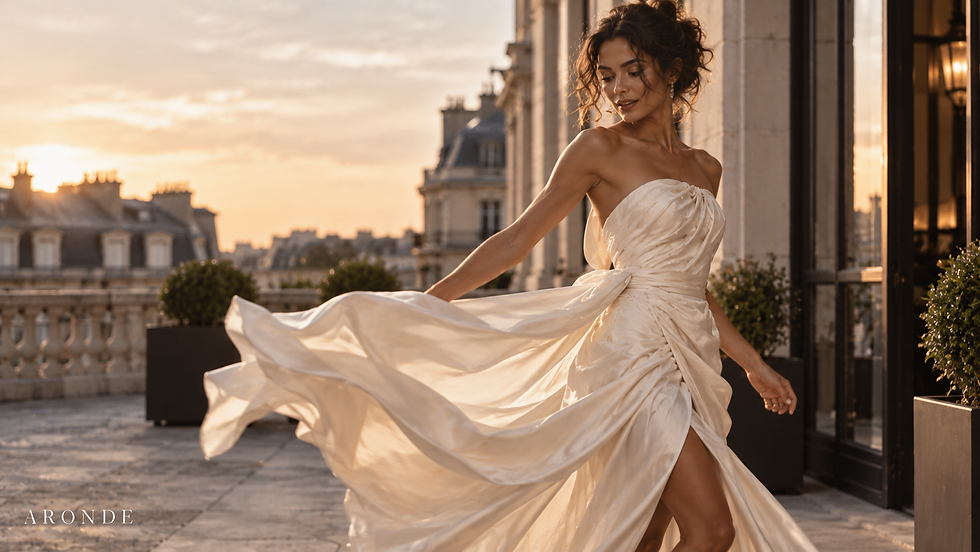
Draping is another prominent Spring 2027 bridal direction, and it has particular potential for a second look because it creates drama through fabric rather than sheer volume.
Soft folds, gathered fabric and fluid panels can make a relatively narrow silhouette visually interesting while allowing the dress to respond to movement.
This can create a very different effect from a structured ceremony gown.
Instead of:
volume + structure + train
the second look might rely on:
movement + drape + body-skimming fabric
That contrast can be enough to make the change feel significant without choosing a more embellished outfit.
But draping needs to be evaluated from more than one angle.
Sit in the dress and see where the fabric gathers. Walk and watch whether a long panel catches around your legs. If the dress has a slit, check how much it opens during normal movement rather than only in a posed photograph.
A garment designed around movement should still work when the movement is yours.
'90s-Inspired Minimalism Offers a Quieter Second Look

Alongside more decorative bridal trends, a quieter direction is also visible for 2027: fluid sheaths, satin, chiffon and pared-back silhouettes influenced by the minimalism of the 1990s.
This can be particularly effective when the ceremony dress is elaborate.
A structured lace gown followed by a fluid satin dress creates an obvious change without requiring the second outfit to become more decorative:
structured ceremony gown → fluid reception dress
or
full skirt → narrow, minimal silhouette
The second look becomes simpler rather than louder.
Minimal construction, however, does not necessarily mean low-maintenance.
Fluid and bias-cut fabrics respond closely to movement and fit. Smooth satin may show creasing, moisture and marks more readily than textured materials, and a dress that looks pristine immediately after steaming may behave differently after sitting through dinner.
Second Looks Move Beyond Pure White

One of the more noticeable developments in Spring 2027 bridal fashion is the use of softer color: muted pinks and blues, deep creams, gray-toned shades and other alternatives to bright bridal white.
A second look offers an easy place to experiment with that direction.
You can keep a traditional white or ivory ceremony gown and introduce color later, or use a subtle tonal shift rather than a dramatic change.
A pale blue, soft blush or deeper cream reception dress may still sit naturally within a bridal wardrobe while giving the second outfit a distinct identity.
There is no requirement for the two dresses to match.
If you want continuity, it can come from something smaller: the same earrings, related fabric texture, similar proportions or repeated accessories.
If you want the second look to feel deliberately unrelated to the first, there is no need to manufacture a connection between them.
Emerging 2027 Directions Worth Watching
Not every interesting runway idea is widespread enough to call a major bridal trend.
Two directions are particularly relevant to second wedding looks for 2027, but are better understood as emerging options rather than universal shifts.
Transformable Bridal Looks
Detachable overskirts, sleeves, jackets and other removable elements are making it possible to create more than one silhouette from the same core outfit.
For a destination wedding, this can be especially useful.
Instead of transporting a ceremony gown plus an entirely separate reception dress, you might wear a dramatic overskirt for the ceremony and portraits, then remove it for dinner and dancing. Sleeves or a jacket can change the proportions again later.
But transformation should do more than change the photograph.
Ask to see the base dress with every removable element taken off. Does it still look intentional from the front, side and back?
Are attachment points visible?
Can the overskirt actually be removed quickly?
Who will know how to do it?
Most importantly, does the transformation solve the reason you wanted a second look?
If the gown remains heavy, restrictive or hot after the overskirt comes off, you may have created two visual versions of the same practical problem.
Bridal Separates and Tailoring

Bridal separates are another direction worth watching: corseted tops, separate skirts, jackets and tailoring that can be combined rather than worn as one fixed dress.
This changes the idea of “dress number two.”
You might keep a corseted top and change from a full ceremony skirt into a shorter one. A jacket can create another version of the outfit later. Tailored trousers can replace a skirt entirely.
There is also potential for reuse. A well-cut jacket or pair of trousers may have a life beyond the wedding that a conventional reception dress does not.
For destination weddings, separates can sometimes be easier to organize because individual pieces can be packed, stored and prepared separately.
But test the complete outfit, not only the pieces.
A corset may feel very different after several hours than it does during a short fitting. A jacket needs enough shoulder mobility for dancing. Trousers should be tried with the exact heel height you intend to wear.
See Bridal Suits, Separates and Jumpsuits: A Practical Guide for more alternatives to a traditional second dress.
What About the Bridal Mini?

The bridal mini remains highly relevant to reception and after-party dressing, even though it is more useful to think of it as a format for several 2027 trends rather than a trend that needs to stand alone.
A mini can be lace, draped, asymmetric, corseted, minimal or part of a transformable bridal look.
Its biggest practical advantage is obvious: there is no long skirt or train to manage.
That can make stairs, crowded reception spaces and dancing considerably easier. But short does not automatically mean comfortable.
A tightly constructed corset can still restrict bending and sitting. A fitted mini may ride up when you dance. A sculptural short skirt can be more difficult to sit in than its length suggests.
When you try one on, don't just stand in front of the mirror. Sit down, raise your arms, walk up a few steps and dance.
If you're changing specifically to move more freely, make sure the second dress actually lets you do it.
Do You Actually Need a Second Wedding Dress?

No.
Multiple bridal looks are increasingly visible in wedding fashion, but that does not make a second dress a requirement.
Before buying one, identify the problem—or experience—you want the change to address.
If the answer is “I want a completely different fashion moment,” a second dress may be exactly what you want.
If it's “I want to dance without managing my train,” find out whether a bustle or removable overskirt could solve the problem first.
If it's “I'll be too hot,” changing from one heavily constructed dress into another heavily constructed mini may not help very much.
And if it's simply “I love my ceremony dress and want to wear it all night,” there is no reason to change because multi-look bridal wardrobes happen to be fashionable.
A second outfit also has a life beyond the few hours you wear it. It has to be bought or rented, altered, transported, stored, prepared, packed again and potentially cleaned, returned, preserved or resold.
Sometimes the right second look isn't a second dress at all.
When Should You Change Into Your Second Wedding Dress?
There is no universally correct moment. The change works best when it corresponds to an actual transition in the wedding.
Changing after dinner makes sense if the primary purpose is dancing.
Changing before the reception creates a clearer separation between ceremony and evening. Waiting until the after-party lets you spend considerably more time wearing your ceremony gown.
There is another consideration that's easy to overlook: your photography coverage.
If professional photographs of the second look matter to you, check where the outfit change falls in the photography timeline. A dress you change into after your photographer has finished coverage may exist primarily in guests' phone photographs rather than in your final wedding gallery.
The venue layout can affect the timing too.
At a large château or countryside estate, the getting-ready room may be several staircases or a substantial walk from the reception. What looks like a five-minute change on the schedule can easily turn into twenty minutes away from your guests.
Before the wedding, decide where the second outfit will be stored, where you'll change, who will help you and what happens to the ceremony gown afterward.
Build the change into your Wedding Day Timeline rather than assuming you'll simply find a convenient moment.
Choosing a Second Dress for a Wedding in France
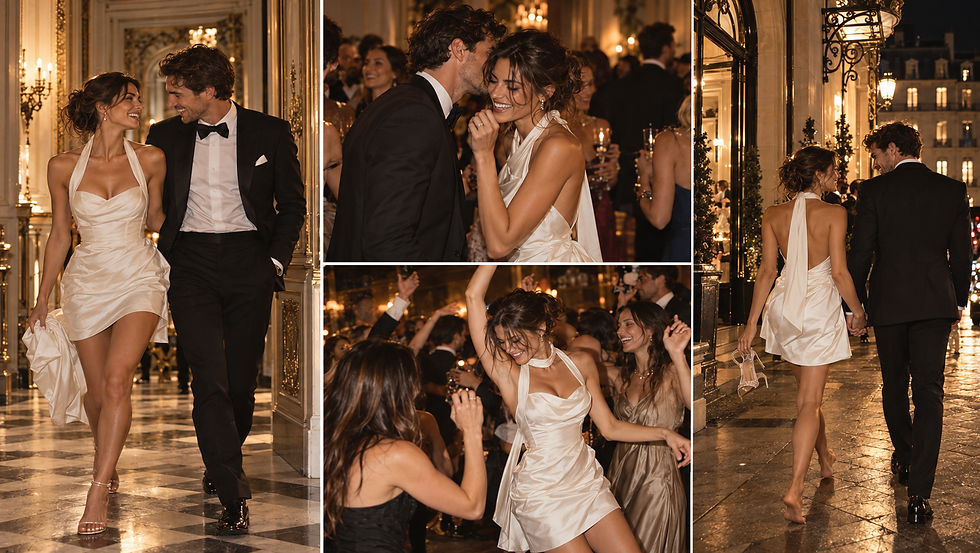
Your venue should influence the practical side of the decision without dictating what your dress should look like.
A Paris hotel, Loire Valley château, Burgundy wine estate, Mediterranean villa and Alpine property create very different conditions for the same outfit.
For a summer outdoor reception, fabric weight and breathability may matter. On the French Riviera, wind can change how loose draping and lightweight details behave. At a historic property, stairs, gravel courtyards and distance between buildings may make a shorter hem particularly useful. At an Alpine or cooler-season wedding, a very light reception dress may require another layer once temperatures drop.
If you're still comparing locations, How to Choose a Wedding Venue in France can help you think beyond aesthetics. Terrain, indoor-outdoor transitions, getting-ready spaces and the distance between different parts of a property can all affect what is practical to wear.
If you're planning to dance until 2 a.m., choose for 2 a.m.—not only for the photograph taken immediately after you put the dress on.
Wear the complete outfit with your actual shoes. Sit in it. Dance. Walk up stairs. Test the closures. Check whether you can use the bathroom without assistance.
Evaluate the dress after several hours of real life, not only during the first thirty seconds in front of a mirror.
One Dress, Two Looks, or a Wedding-Weekend Wardrobe?
All three approaches can work.
One dress may be enough if you want your ceremony gown to remain the focus and it is comfortable for everything you plan to do.
One transformable dress can create a substantial visual change without requiring another complete outfit.
Two dresses make sense when the ceremony and reception ask different things from your clothes—or simply because wearing two distinct looks will add something meaningful to your experience.
A larger wedding-weekend wardrobe can make sense when you have several genuinely different events: welcome drinks, a civil ceremony, the wedding, an after-party and a farewell brunch.
But several events do not automatically require several new outfits.
Look at the weekend as a wardrobe system. Some pieces can be reused or restyled, and some events simply don't need a dedicated bridal look.
If you're earlier in the process, start with How to Plan a Destination Wedding in France before building fashion decisions around a venue, season or wedding format you haven't chosen yet.
For 2027, the most interesting second-look trends are not really about convincing brides to buy more dresses. They are expanding the ways a bridal wardrobe can change: through lace and color, different necklines and proportions, fluid draping, modular pieces or an entirely different silhouette.
So instead of beginning with:
What should my second wedding dress look like?
start with:
What do I want to be able to do—and how do I want to feel—once I change into it?
The answer makes the fashion much easier to choose.


