
Wedding Venues in Bordeaux & Southwest France: A Complete Guide for 2027
Updated: Oct 13

From the wine châteaux of Saint-Émilion and Médoc to historic Dordogne manors and private estates in Gascony, discover how to choose the right setting for your destination wedding in France.

For couples planning a destination wedding in 2027, exploring wedding venues in Bordeaux alongside historic manors in Dordogne and private estates in Gascony reveals just how different the region's settings can be. Each offers its own combination of architecture, accommodation, services, and wedding experiences.
A château in the Bordeaux vineyards and a country manor in Dordogne can look equally appealing in wedding photographs. Both might have pale stone walls, mature gardens, elegant reception spaces, and a terrace where guests can gather over a glass of wine.
Yet the experience of getting married in these properties may be remarkably different.
A Bordeaux wine château might still be an active vineyard estate, with its own hospitality arrangements and established reception spaces. A manor in Dordogne may be rented as a private residence for several nights, leaving you to organize catering and other services independently. Farther south, some Gascony properties operate as fully serviced wedding destinations, complete with accommodation, catering, and an in-house planning team.
These distinctions are particularly relevant if you're organizing your wedding from abroad. A venue's location affects how guests arrive, where they stay, and whether the celebration can unfold comfortably over an entire weekend. Its operating model determines which services are already provided and which must be arranged separately.
For couples planning a wedding in Bordeaux or Southwest France in 2027, the most useful starting point is understanding what each part of the region—and each type of property—actually offers.
Bordeaux or the Wider Southwest: Which Setting Suits Your Wedding?
Bordeaux is the region's most recognizable international destination, but its surrounding wine country is only one part of a much larger landscape. Southwest France includes river valleys, medieval towns, agricultural countryside, fortified villages, and historic estates whose architecture changes as you travel inland.
Around Bordeaux, the wine industry has shaped both the countryside and its buildings. Elegant eighteenth- and nineteenth-century residences sit among vineyards, sometimes alongside older farm buildings, wine cellars, and landscaped parks. Some are substantial private estates; others are working wineries that offer selected spaces for receptions and events.
Dordogne has a different character, particularly in Périgord Noir, where wooded valleys, medieval fortifications, steep village streets, and honey-colored limestone buildings create a more rural setting. Wedding properties often include former family residences, restored farmhouses, or larger estates with several accommodation buildings.
Gascony, including much of Gers and neighboring countryside, offers another interpretation of a French country wedding. Here, historic houses and agricultural estates are spread across rolling landscapes, often at a considerable distance from major towns. The appeal is less about belonging to a famous wine appellation and more about privacy, space, and the opportunity to gather everyone in one place.
A couple looking for a formal château reception with relatively convenient access to Bordeaux may prefer Gironde, the department surrounding the city. A couple hoping to spend three days together in a large private house might find a better fit farther inland.
Neither approach is necessarily more affordable or easier to organize; much depends on
whether you're renting only the property or buying a more complete hospitality experience.
Where to Find Wedding Venues Around Bordeaux

Saint-Émilion & Libournais: Wine Estates and Historic Limestone Architecture
Saint-Émilion has a particularly recognizable setting: a medieval limestone village surrounded by vineyard-covered slopes, old stone walls, and historic wine properties. The surrounding Libournais area includes substantial château residences as well as more modest estates whose appearance reflects generations of wine production.

The village itself is a natural destination for guests who want to explore the area before or after the wedding. Libourne, meanwhile, provides a railway connection and an accommodation center that may be useful when considering properties east of Bordeaux.
The estates vary considerably in how they operate. Some welcome private receptions but have little or no accommodation, while others offer a residential wedding weekend with exclusive use of the property.
One example is Château de Garde, in Moulon, between Bordeaux and Saint-Émilion. The property has a reception hall for up to 120 seated guests and offers private use for a minimum of a full weekend. Rather than providing its own catering service, it operates primarily as a rental venue, allowing couples to choose their suppliers.
Its published rules also distinguish between music outdoors, which must finish at 10 p.m., and music in the reception hall, which can continue until 4 a.m. That difference has an immediate effect on the structure of a wedding: a courtyard dinner might be followed by dancing indoors, rather than attempting to hold the entire evening outside.
For couples who prefer freedom to assemble their own team of professionals, this kind of arrangement may be attractive. It does, however, create more supplier coordination than a property where catering and event production are managed by one permanent team.
Médoc: Celebrating Among Bordeaux's Great Wine Estates

Northwest of Bordeaux, the Médoc stretches along the Gironde estuary through some of France's best-known wine-producing areas. Its landscape is characterized by vineyard estates, long approaches, substantial château residences, and agricultural buildings that belong to the working wine properties.
This is an interesting destination for couples drawn to the architectural heritage of Bordeaux wine rather than simply to the idea of a country house.
Château Giscours, a historic wine estate in Margaux, demonstrates how varied the spaces of a working château can be. Its event facilities include the château, park, former agricultural buildings, and La Ferme Suzanne. The latter has a large courtyard with a covered hall of approximately 400 square meters and a reception room of approximately 432 square meters.
The appeal is not limited to the château façade. Former agricultural spaces can give a large celebration a very different character from a formal reception in a principal residence, while providing substantial room for dining or other parts of the event.
It would be a mistake, however, to assume that every prestigious Médoc winery operates in this way. Some estates concentrate on wine production and visitor experiences, while others have dedicated event facilities. Begin by identifying properties that expressly accommodate weddings, then establish which parts of the estate can be privately used.
For guests staying in Bordeaux, Médoc also requires careful geographical consideration. The region covers a long stretch of wine country, and a property farther north may be a substantially different journey from one close to the city's outskirts.
Graves & Pessac-Léognan: Historic Vineyards Near the City
The wine-growing districts of Graves and Pessac-Léognan extend south of Bordeaux. Unlike more remote vineyard areas, parts of this landscape sit close to established suburbs and the wider metropolitan area.
That proximity gives some estates a distinctly different setting. Historic gardens and vineyard parcels may sit within an increasingly urbanized environment, making the relationship between wine heritage and city access more noticeable.
Château Pape Clément, in Pessac, is an example of a historic classified-growth wine estate that offers private events alongside wine tourism and hospitality. Its history is closely tied to Bordeaux winemaking, while its location places it much closer to the city than an isolated estate in northern Médoc.
For international couples, a venue in this area may make it possible to combine a vineyard celebration with accommodation in or around Bordeaux. Whether that works depends on the specific property, the available event spaces, and the final transport arrangements.
A venue's proximity to the city can simplify some decisions without turning a wine château into an urban hotel. The reception may still require privately organized transport, especially if guests leave at different times late in the evening.
Entre-deux-Mers: Country Properties Beyond the Famous Appellations
East of Bordeaux, between the Garonne and Dordogne rivers, Entre-deux-Mers offers rolling vineyards, wooded countryside, bastide towns, and numerous historic residences.
Its château properties do not all follow the same model. Some are associated with agricultural and wine production, while others operate as restaurants, hotels, private estates, or dedicated venues.
Château Camiac, in Camiac-et-Saint-Denis near Créon, offers an example of a château with a hospitality business rather than a straightforward private-house rental. The property advertises wedding receptions, heated and air-conditioned rooms, an on-site restaurant with its own chef, and a landscaped park of approximately eight hectares.
The distinction matters when comparing proposals. A property with an established restaurant and hospitality team may be able to provide services that another country château expects you to source independently. That does not automatically make it the more economical option, but it changes the work involved in producing the wedding.
For couples who like the Bordeaux countryside without needing a famous grand-cru estate, Entre-deux-Mers is a sensible area to include in the search.
Dordogne: Historic Manors, Country Houses and Private Wedding Estates

The landscape changes as you travel east toward Dordogne. Vineyards remain important around Bergerac and Monbazillac, but elsewhere the region becomes increasingly associated with wooded valleys, limestone cliffs, medieval villages, and historic country houses.
These differences are visible in the venues themselves.
Around Bergerac and the southern Dordogne countryside, you can find estates with vineyards, gardens, and a mixture of historic residential and agricultural buildings. Farther east, particularly around Sarlat-la-Canéda and the Dordogne Valley, medieval architecture and the wooded landscape become more prominent.
The distinction is useful when choosing where guests will spend several days. An estate near Bergerac may make it easier to combine the wedding with wine visits and local towns, while one near Sarlat might offer access to the historic villages and river landscapes associated with Périgord Noir.
A private estate does not have to be monumental to work well for a destination wedding. Some of the most practical properties are substantial country houses with several bedrooms, an appealing garden, and appropriately designed reception spaces.
Château Lacanaud, in the Dordogne countryside near Eymet, represents this more residential style of celebration.
The estate includes woodland, gardens, a lake, and accommodation for up to 23 guests, with private bathrooms attached to its bedrooms. Weddings can make use of different parts of the property throughout the weekend.
For a celebration of 60 or 80 guests, the estate may provide a comfortable base for the couple and their closest relatives while other attendees stay nearby. For a much smaller gathering, the same arrangement might allow almost everyone to stay together.
That flexibility is part of the appeal of Dordogne, but it also means that accommodation should be evaluated room by room rather than solely through a headline sleeping capacity.
Gascony: A More Residential Wedding Weekend
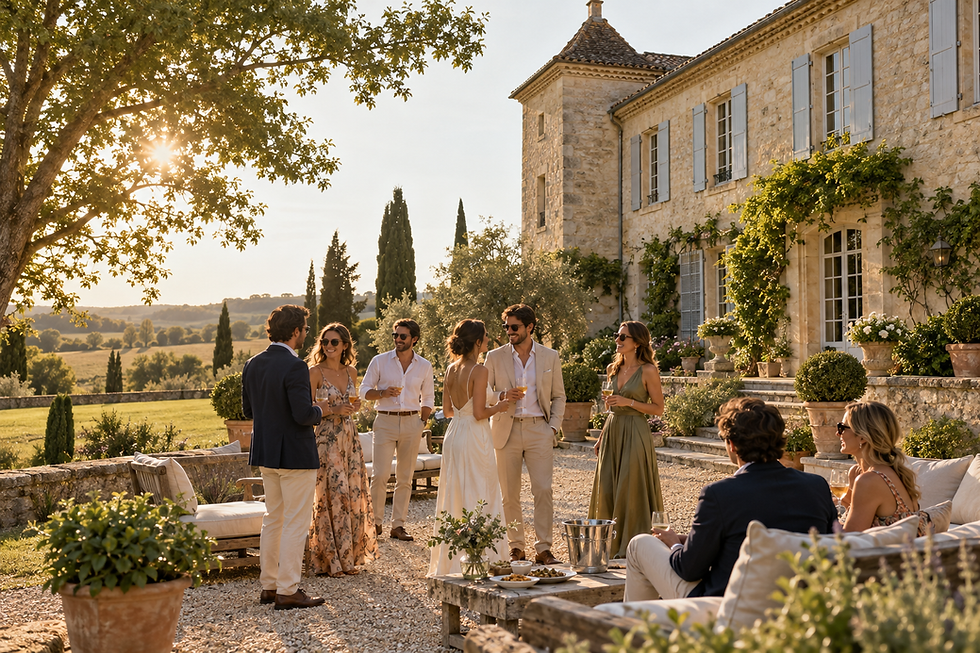
Gascony deserves more attention than it typically receives in broad lists of French wedding destinations. Much of Gers is characterized by rolling agricultural countryside, historic villages, traditional farm buildings, and country residences whose setting is quite different from the formal vineyards of Bordeaux.
Its wedding estates may also operate differently.
Château de Lartigolle, near Auch in Gers, offers a useful contrast to a venue such as Château de Garde. Rather than functioning primarily as a rental property where outside professionals assemble the event, Lartigolle uses a permanent in-house team that includes planners, chefs, florists, service staff, and housekeepers.
The château accommodates up to 28 guests in 12 bedrooms and describes 80–100 guests as an ideal wedding size, with capacity for up to 120. Its wedding format is built around a three-night stay, with events taking place across several spaces, including a courtyard, vaulted cellar, and dedicated party area.
That operating model changes the planning experience. Instead of coordinating numerous unrelated service providers, the couple works with an established team responsible for much of the weekend.
Lartigolle advertises a minimum overall wedding budget of €36,000 for a three-night celebration, with the precise quotation depending on guest numbers and arrangements. Its published inclusions extend beyond accommodation and the reception: they cover planning, several meals, staffing, styling elements, allowances for flowers and drinks, and some transportation provision.
The minimum is not a universal 2027 price or a comparable rental fee for an empty property. It is an example of what a more complete, serviced wedding weekend can cost.
For couples considering Gascony, the comparison is therefore not simply between a remote château and a more accessible Bordeaux estate. It may also be between two entirely different ways of organizing the wedding. How to Choose a French Venue for a Multi-Day Destination Wedding
How to Choose Between a Wine Château, a Private Estate and a Château Hotel
Three properties might each advertise exclusive use, historic architecture, and accommodation. Yet the level of service can be very different.
At a working wine château, event facilities may exist alongside the agricultural business, with specific areas reserved for weddings. At a private country estate, the emphasis may be on residential accommodation and grounds, with caterers, decorators, and other professionals hired independently. At a château hotel, accommodation and hospitality are established services, although the extent of event planning and exclusivity still needs to be established.
Consider Château de Garde and Château de Lartigolle.
Château de Garde offers a reception hall, accommodation, exclusive weekend rental, and considerable freedom to select suppliers. The couple is responsible for assembling the wider event arrangements, unless additional planning services are purchased.
Lartigolle, by contrast, provides a multi-day celebration organized by its own permanent team, with hospitality and several event services integrated into the experience.
Neither model is inherently preferable. The first may suit couples working with an independent planner or those who want greater control over supplier selection. The second may suit those who prefer a property where much of the weekend is already managed within one organization.
A château hotel offers another possibility, especially when guest accommodation, restaurant service, and professional hospitality are priorities.
Rather than deciding by architectural category alone, compare what each venue expects you to arrange after signing the contract.
What Is Different About Getting Married at a Working Wine Estate?

A wedding in Bordeaux's vineyards can be closely connected to the region's wine culture, but a working estate is not simply a decorative backdrop.
Vineyards are cultivated, grapes are harvested, and production or visitor activities may continue at certain times of year. The arrangement of the property determines how much of that activity is visible to guests and whether any part of it intersects with the wedding.
Harvest season, known in French as the vendanges, usually takes place from late summer into autumn, although timing varies considerably with the year, grape variety, and producer.
A September wedding at a wine estate can coincide with this period. That is not inherently a problem: many properties are accustomed to hosting events while operating as wineries. What matters is knowing which parts of the property will be exclusively reserved and how guests and suppliers will move through the estate.
Wine service also deserves attention. A Bordeaux property may offer its own wines, work with a preferred supplier, or allow outside bottles. Where outside wine is permitted, a droit de bouchon—a corkage charge—may apply.
Policies differ enough that general assumptions are unhelpful. Château Gassies, for example, expressly allows couples to bring their own wine without a corkage fee under its published 2027 wedding offer. This is a meaningful inclusion for couples who want flexibility over the reception wine selection.
Finally, distinguish between spaces intended for wine visitors and those designed for wedding events. An atmospheric tasting room may suit a small welcome gathering, while a larger dinner or late-night celebration could require a separate reception hall.
How Much Do Wedding Venues in Bordeaux & Southwest France Cost in 2027?

Published prices across the region cover several different products: simple property rental, exclusive weekend use, accommodation-inclusive hire, and more comprehensive wedding packages. Treating all of them as equivalent château rental fees would produce a misleading comparison.
For Dordogne, published market planning guides have placed smaller manoirs and farmhouse-style properties broadly around €3,000–€8,000, with some château weekend rentals around €5,000–€15,000. These are market planning ranges rather than guaranteed 2027 offers, and larger or more extensively serviced properties can cost considerably more.
A more precise comparison comes from properties that publish their actual packages.
Château Gassies: Published 2027 Wedding Prices
Château Gassies, near Bordeaux, offers a particularly useful example because it publishes prices for different periods of 2027.
For exclusive use over two nights, checking in on a Friday, the published weekend prices are:
2027 wedding period | Two-night weekend package |
April | €23,000 |
May and October | €25,000 |
June and September | €26,500 |
July and August | €28,000 |
The package includes exclusive use of the estate, accommodation and daily breakfast for up to 43 guests across six suites and three guesthouses, and access to several facilities. The wedding reception can accommodate up to 150 guests, with tables and chairs provided for the main reception.
The same offer includes a selection of spaces for the ceremony, cocktail hour, and welcome gathering, as well as covered courtyards that can be used in case of rain. Cleaning of the event spaces, tourist tax, and overnight security on the wedding night are also included.
The price difference between an April weekend and a July or August weekend is €5,000 for the same two-night format. That is a material variation before adding catering, photography, flowers, and other external services.
A third night also changes the quotation. Château Gassies publishes three-night weekend packages from €28,500 in April to €35,000 in July and August. This allows couples to evaluate the cost of extending their stay rather than assuming an additional night will be priced like ordinary hotel accommodation.
The quoted rental package does not mean that a complete wedding for 150 guests costs €23,000. Catering and other external services still need to be budgeted, and some additional uses of the property are offered at a separate charge.
A €36,000 Wedding Weekend Is Not the Same as a €36,000 Venue Rental
The published minimum of €36,000 at Château de Lartigolle illustrates a different kind of quotation.
That amount is a minimum overall budget for a three-night wedding arrangement, with several services included or provided through allowances. The venue's published offer encompasses a resident planning team, meals across the stay, wedding hospitality, staffing, and other event components.
Photography, videography, hair and makeup, and the celebrant are among the services that the property identifies as outside its offer.
Comparing Lartigolle's minimum directly with the Château Gassies rental price would therefore be misleading. One price represents a broader serviced experience, while the other covers a particular exclusive-use estate package.
The same distinction applies when evaluating a privately rented manor in Dordogne. A lower advertised rental fee does not automatically mean a lower final wedding budget, particularly when food, equipment, staffing, and services must be sourced separately.
For a full explanation of the costs beyond venue hire, see How Much Does a Wedding in France Cost?
Why the Layout of the Property Matters
One of the less obvious differences between French wedding venues is the relationship between the property's event capacity and its residential accommodation.
At Château Gassies, a reception can accommodate up to 150 guests, while accommodation is provided for up to 43. A wedding near the maximum reception capacity would therefore involve a substantial number of people staying elsewhere.
At Château de Lartigolle, accommodation is available for up to 28 guests, even though the property can host a considerably larger celebration.
These arrangements can work extremely well when the accommodation strategy is deliberate. The difficulty arises when a couple assumes that an exclusive-use wedding estate automatically offers a residential experience for the entire guest list.
The bedroom configuration also matters.
At Château de Garde, accommodation is distributed among rooms in the château, a separate house, and an annex. The property offers different arrangements, including shared sleeping facilities, rather than a uniform collection of conventional hotel bedrooms. Its maximum capacity depends on how these spaces are used.
For a family group with children or close friends happy to share facilities, that flexibility may be welcome. For guests expecting private rooms and bathrooms, the same layout may need a different allocation strategy.
For larger celebrations, the next decision is not simply how many guests stay off-site, but where that accommodation will be concentrated. A group spread between Bordeaux, Saint-Émilion, and smaller countryside properties creates a different transport plan from one staying in a single hotel near Libourne.
The detailed guide Wedding Guest Accommodation in France explains how accommodation choices affect the rest of the wedding arrangements.
The Reception Space Can Change the Wedding More Than the Garden
It is easy to select a château because of its outdoor setting. Bordeaux offers vineyard terraces and landscaped grounds; Dordogne has stone courtyards, wooded gardens, and terraces overlooking the countryside.
But the indoor spaces often determine how adaptable the wedding can be.
At Château Giscours, the substantial reception facilities at La Ferme Suzanne demonstrate how former agricultural buildings can become major event spaces. At Château Gassies, the Charles X reception hall offers a seated dinner capacity of up to 150, with covered alternatives for other parts of the celebration.
At Château de Lartigolle, the vaulted cellar and dedicated party space provide alternatives to an entirely outdoor wedding evening.
These are different architectural solutions to the same practical issue. An attractive garden can host a ceremony or cocktail hour, but it cannot replace a suitable indoor dinner or party space when weather or event conditions change.
For a 100-person wedding, a beautiful interior that accommodates only 60 people for a seated meal is not a complete alternative to outdoor dining. The remaining capacity must come from another space or an additional structure, and the cost can change considerably.
Indoor spaces can also determine how late a celebration continues. Château de Garde's published distinction between outdoor music ending at 10 p.m. and indoor music ending at 4 a.m. is a particularly clear example.
These conditions are specific to individual venues, not general noise regulations for the whole region.
The Best Season for a Bordeaux or Dordogne Wedding
The vineyards give Bordeaux a seasonal identity that changes visibly throughout the year.
In spring, fresh growth gradually returns to the vines, while gardens and countryside take on their early-season colors.
Late spring and early summer offer long days for outdoor celebrations, although rainfall remains possible. How to Evaluate a French Wedding Venue's Rain Plan
July and August can be warm or hot. A historic château with air-conditioned accommodation may still have separate spaces that are not cooled, including certain salons, older buildings, or preparation rooms. The relevant distinction is which rooms guests will actually use during the day.
September brings particular interest to Bordeaux because of the grape harvest. Depending on the year and estate, active vineyard operations may be visible nearby. It is also a period when warm afternoons and cooler evenings can create different requirements for an outdoor ceremony and later dinner.
October can provide changing vineyard colors and a quieter countryside atmosphere, but daylight hours shorten and weather becomes less predictable.
Dordogne and Gascony offer their own seasonal contrasts, with green countryside in spring, summer heat, and softer autumn landscapes.
For a private estate where the principal dining area is outdoors, the quality of the indoor alternative matters more than the month alone.
If you are comparing two venues for a September 2027 wedding, their actual spaces and arrangements will tell you more than generic descriptions of autumn in Southwest France.
Getting There from the United States or the UK

Bordeaux is one of the more accessible gateways to Southwest France, with an international airport and high-speed rail connections to Paris.
Direct high-speed trains between Paris Montparnasse and Bordeaux Saint-Jean can take approximately two hours on the fastest services, making Bordeaux practical for guests who spend time in Paris before the wedding.
Bordeaux Mérignac Airport may also be convenient depending on the available flight connections. For some venues in Dordogne, Bergerac Dordogne Périgord Airport may offer a closer arrival point, while estates in Gascony may be better approached through Toulouse.
The appropriate gateway depends on the final venue location, not simply on the region named in the wedding invitation.
A property near Libourne or Bordeaux may allow guests to stay in a larger town and travel to the reception. A secluded manor in Dordogne or Gascony is more likely to require a deliberate last transfer, particularly if guests are arriving with luggage or returning after midnight.
For an international wedding, confirm the route to the actual entrance of the venue, rather than relying on the nearest major city as a measure of accessibility.
Which Wedding Setting Should You Choose?

A Bordeaux wine château may be the right choice if the identity of the region matters to you: its vineyards, established wine culture, and distinctive historic properties. Saint-Émilion offers a particularly recognizable setting, while Médoc and Graves have their own architectural and geographical character.
Dordogne is worth considering if you prefer historic country houses, medieval landscapes, and an estate that can become the center of a wedding weekend. Its venues vary enormously in size and service level, so the most appealing property may not be the grandest château.
Gascony offers a different opportunity, especially for couples who want privacy and a residential celebration. Some properties provide only the venue, while others, such as Château de Lartigolle, organize an extensive part of the wedding through their own teams.
There is no reason to assume that one area is always more economical.
A simpler property with a lower rental fee can require substantially more outside services, while a higher-priced venue might already include accommodation, meals, furniture, and staffing.
Once you have two or three promising estates, the comparison becomes more concrete. Request proposals for the same wedding dates, guest count, and intended length of stay. Then establish what each property actually includes and how much additional work remains.
A villa-style residence in Dordogne and a wine château near Bordeaux may both be suitable for 80 guests, but they may produce entirely different proposals, accommodation arrangements, and weekend experiences.
Before You Book the Venue
Finding a château you love is only the beginning. Before committing to a property, you'll want to understand how well it accommodates your guest list, whether its indoor and outdoor spaces suit your celebration, and what the proposed rental arrangements actually include.
If you're still narrowing down your options, start with How to Choose a Wedding Venue in France. It will help you establish which characteristics matter most before building a shortlist, so you're not comparing properties based on photographs and architecture alone.
For couples traveling from abroad, visiting several venues requires a little more preparation. How to Plan a Wedding Venue Scouting Trip to France From the US explains how to organize your itinerary, arrange appointments, and make the most of limited time on the ground.
During each visit, look beyond the spaces featured in promotional photographs. Pay attention to how the ceremony, cocktail hour, dinner, and dancing areas connect, where guests would gather in bad weather, and how accommodation is distributed throughout the property. Record your impressions immediately afterward, while the details are still fresh.
Our free guide, Before You Book the Venue — 60 Essential Questions, is designed to make those visits more productive. Print a separate copy for each property, bring it to your appointment or video call, and use the answer spaces to document both practical details and your personal impressions. Having the same information for every venue makes the final comparison considerably easier.
The most suitable Bordeaux or Southwest France wedding venue isn't necessarily the most famous wine château or the property with the lowest advertised price. It's the one whose setting, facilities, accommodation, and arrangements work together to support the celebration you want to host.


